Article
BeginnerYour Event's Front Door Is a Data Problem
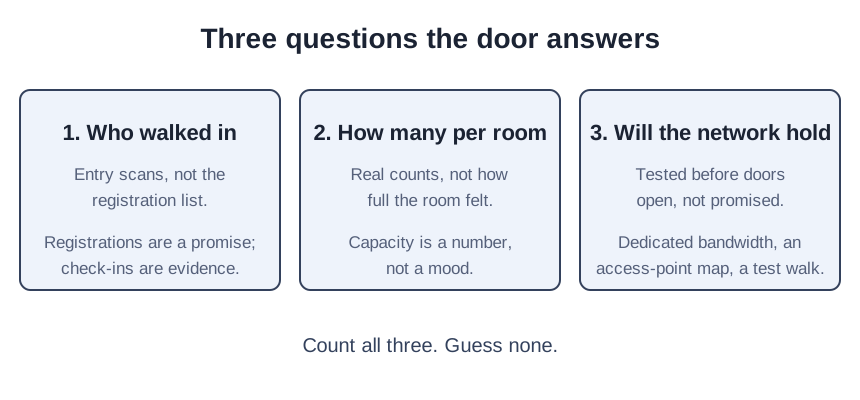
Your event's three most expensive questions are answered at the door: who walked in, how many are in each room, and whether the network survives.
Events Attendance Check In Wifi Exhibitors
Doors open in twenty minutes, and the three questions that matter already have answers you cannot see. How many of your registered members will actually walk in. How many people will be in each room at any given moment. Whether the venue’s network survives everybody connecting at once. Most associations answer all three with guesses: the registration list, a glance at the room, and the venue’s promise of great Wi-Fi. The front door is where those guesses turn expensive.
The staff are not careless with data. The data worth having lives at the door, and nobody built the door to collect it. Registration software was built to take money and print badges. Room signs were built to label sessions. The venue’s internet was built for the building’s normal Tuesday. None of them were built to report what actually happened when your members arrived.
The registration list is a promise, not a count
Your registration system will report a proud number. The caterer, the exhibitors, and your board want a different one: how many people actually showed up. A registration is a statement of intent, and intent costs the attendee nothing to make and nothing to break. People register early, then a budget freeze hits, a flight gets canceled, or a Tuesday webinar turns out to be good enough. Some register twice under two email addresses. Some cancel and the refund never clears the list. The scan at the door is the only number that was earned one badge at a time.
This matters beyond logistics. When you report attendance to sponsors and the board, registrations are a promise and check-ins are evidence. A sponsor who paid for access to your members deserves the evidence number, not the promise number. We think most post-event reports lean on the promise number because it is bigger, and bigger numbers are easier to present. That is exactly why the number in the report needs to be the honest one.
Rooms are counted by feeling, and feeling lies
Ask any events team how the breakout sessions went and the answer comes back in adjectives: packed, thin, standing room only. Adjectives are not data. Two rooms can feel equally full with very different counts, and the difference is the whole story: which sessions to repeat next year, which topics to retire, which sponsors belonged in the big room, what to tell the board about demand.
There is a sharper edge to it. Every room has a posted capacity, and the line between a full room and an overfull one is a number, not a mood. “It looked fine” is how an association drifts past a limit the venue set in writing. Counting the door is not just better reporting. It is the only way to know you stayed inside the lines.
The venue’s Wi-Fi is a promise, too
The third guess is the network, and it fails the same way. The venue says the Wi-Fi is great, and on the site visit it was: an empty ballroom, one laptop, a speed test that sang. Then the crowd walks in carrying their phones, tablets, and laptops, and the network that was promised no longer exists.
We read IACC’s venue internet guidance expecting the usual advice about speed tests, and the part that stood out was the device count: delegates now arrive with two or three devices each, so the network is serving multiples of the headcount. That same IACC guidance says shared bandwidth, the kind a building splits among whoever happens to be there, is generally not acceptable for meetings and events; planners should ask for dedicated bandwidth, an access-point map, and someone on site when it breaks. Some planners, IACC notes, now ask attendees how many devices they are bringing as part of registration itself, which is not nosy. It is capacity planning. And IACC’s checklist includes asking whether the property will provide a report on the meeting’s bandwidth usage afterward, which is free data about your actual crowd that almost nobody asks for.
Count three things
Count the entry. Whatever check-in system you already own records a scan per badge. Reconcile scans against registrations after the event, keep both numbers, and the gap between them becomes your planning number for next year. No new software, no new hardware: the count is already sitting in the system you paid for. If the entry line itself is the bottleneck, a face-verified express lane can admit members who enrolled at registration with no scan at all: the full build is here.
Count the rooms. A volunteer with a clicker at the door for the first ten minutes of each session produces a real number for almost no money. If you want it passive and continuous, cheap WiFi boards at the doorways can tell entries from exits and time how long people stay: the foot-traffic build is here.
Test the network before doors open. Add a device-count question to registration, since some planners already do. Ask the venue in writing for dedicated bandwidth rather than shared, an access-point map, on-site support, and a post-event usage report. And walk the building with your phone before the event to map every network actually broadcasting in it, including any that are impersonating yours: the wardrive walkthrough.
One meeting, three numbers
This is a teaching example, not a case study. The Meridian Manufacturers Council books a regional meeting for a Friday. Registration closes at 420. The badge scans at the door total 352. One breakout room with a posted capacity of 80 gets a clicker count of 96, and the team moves the repeat session to the ballroom the following morning. The venue had promised plenty of bandwidth, but morning check-in slows to a crawl when three hundred phones join the network at once; the planner had never asked for dedicated bandwidth in writing, so there is nobody on site to call.
Nothing in that story required new technology. The scans were already in the registration system. The clicker cost a few dollars. The bandwidth question costs a sentence in an email. The data was at the door the whole time. The association just had to collect it.
Three routes, depending on what you have
The no-budget route. The badge scans you already own, a clicker at the door, and the venue questions above asked in writing. After the event, paste the check-in export into a free AI assistant and ask which sessions filled and which ones drew the least. This route costs nothing beyond staff time, and it fixes the biggest gap: treating registrations as attendance.
The hardware route. If the budget stretches to it, the express entry lane and the doorway counters above run on commodity parts and free software, and the venue walk needs only a phone. This is the route for teams that want the counts without staffing every door.
The analysis route. None of the analysis here needs a paid AI plan or a capable GPU. Summarizing check-in data, drafting the venue’s bandwidth questions, and comparing this year’s scans to last year’s registrations are all plain-text tasks any free assistant handles. Save the budget for the clickers.
The caution: only count what you will use
A number nobody acts on is not an insight. It is a file you have to store, protect, and explain. Entry scans tied to badge numbers are member records, so handle them like the rest of your membership data and keep them no longer than your own retention habits allow. Report only numbers you can reproduce: if the count came from a volunteer with a clicker, say so in the methodology note. And never pad the report. The door rewards honesty, and it punishes the spreadsheet that was filled in from hope.