Article
BeginnerStaff Use AI Quietly Because Honesty Gets Punished
New research on hidden AI use finds staff hide it for rational reasons: disclosure gets effort undervalued, low trust quadruples withholding, and unclear policy makes silence the safe move. The fix is a trust response, not a monitoring response.
Shadow AI Staff Trust AI Policy Association staff
Your membership coordinator drafts the lapsed-member renewal email in a personal chatbot account, pastes the finished text into the association’s email system, and closes the tab before the morning standup. This is a teaching example, not a case study. The behavior behind it is real enough that researchers have now given it a name: AI disclosure silence, the intentional withholding of information about AI’s role in finished work (a 2026 study of marketing employees).
The study’s finding reframes the whole problem. The employees it surveyed were not avoiding AI or resisting it. They were using it, then deliberately deciding not to say so. The question for an executive director is not how to get staff to try the tools. They already have. The question is why telling the truth about it feels unsafe, and what changes that calculation.
Hiding is a rational response to how disclosure gets treated
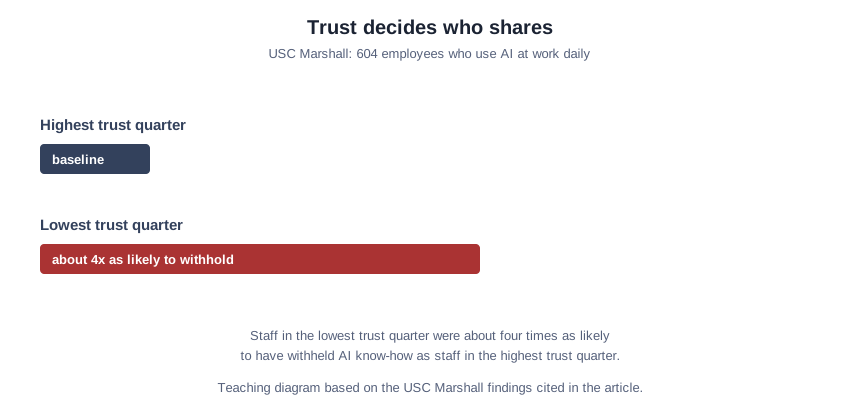
Researchers at the USC Marshall School of Business surveyed 604 U.S. employees who use AI at work daily or multiple times per day. Four out of five said sharing their AI techniques would benefit their team. Nearly one in three withheld AI knowledge, workflows, or techniques from coworkers or employers anyway. What separated the sharers from the withholders was trust in the organization: people in the bottom quarter on trust were about four times as likely to have withheld something as people in the top quarter.
The reasons staff gave are uncomfortably rational. First, reputation: research the USC team cites finds that learning someone used AI leads observers to attribute less competence, motivation, effort, creativity, authenticity, and trustworthiness to that person. Second, workload: staff worried that demonstrated efficiency would be rewarded with more work or an unwanted new identity as the office AI spokesperson. Third, replaceability: showing exactly how the job gets done felt like writing the instructions for one’s own replacement.
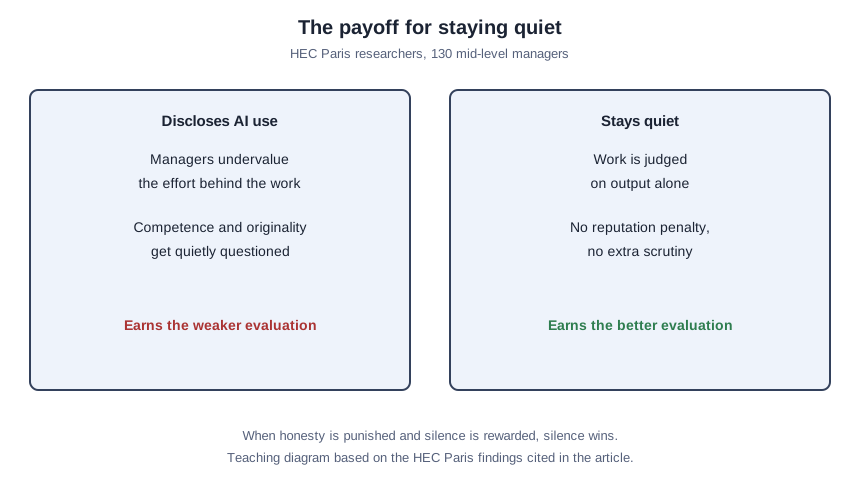
A separate line of research says the reputation fear is justified. HEC Paris researchers studied 130 mid-level managers and found that content produced with AI assistance was evaluated more favorably, but when managers knew AI had been used, they undervalued the effort behind it. Analysts who concealed their AI use received better evaluations. The incentive structure pays people to stay quiet. Even disclosed honesty did not buy trust: many managers still suspected AI use in work where none had occurred.
The 2026 Behavioral Sciences study adds the organizational conditions that complete the picture. Across its configurations, the same factors kept appearing alongside high disclosure silence: fear of negative evaluation, AI anxiety, perceived threats to creativity and job security, low trust in management, weak psychological safety, and unclear AI policy. No single factor was the whole story. But unclear policy plus low trust was a combination that showed up repeatedly, which matters because those are the two things leadership directly controls.
The public-sector evidence points the same way. A survey of 576 public managers across seven EU countries found 30% already using generative AI in daily work, with more planning to adopt, much of it happening without formal frameworks. The authors call it shadow use: autonomous, undocumented, and invisible to organizational processes. Associations live in the same world as those public managers: mission-driven staff, member data, and no procurement department standing between a curious employee and a free chatbot account.
The compliance response treats a trust problem like a rule problem
The instinct, when leadership discovers quiet use, is to reach for control: an approved tool list, a monitoring mechanism, a mandatory disclosure rule. We think that instinct misreads the research. The USC researchers put it bluntly: it is not enough to release a policy that claims to support AI use. Employees in interviews could tell within the first thirty seconds of disclosing whether a supervisor was genuinely supportive, and a disclosure met with punishment or heavier workload taught everyone watching to stay quiet next time.
This is where we disagree with part of the published advice. The HEC Paris team recommends mandatory disclosure plus structured monitoring as elements of corporate AI policy. Disclosure rules are fine. But a mandate without the trust conditions just moves the hiding somewhere harder to see: the research shows concealment still earns the better evaluation. Monitoring answers the question of which tools are in use while leaving the actual question, why would anyone tell us, untouched.
There is also a cost to getting this wrong that goes beyond governance. When useful AI methods stay locked inside individual heads, the organization cannot train anyone else on them, and leadership makes decisions from an inaccurate picture of workloads and performance. The USC researchers note that a fast analyst with an invisible method leaves management not knowing what it is paying for. Quiet use is not just a governance risk. It is an information loss.
Make honesty the safer career move
If hiding is rational, the fix has to change the arithmetic, not just the rules. Three moves do that, and none of them is a new monitoring tool.
First, separate disclosure from evaluation. Say plainly, and mean it, that admitting AI use will never be counted against someone’s competence, and then prove it in the next performance review cycle. The USC researchers suggest crediting staff in reviews for methods others adopt, protecting time to keep experimenting, and sharing the gains when a workflow spreads. The principle is simple: the person who brings a working method into the open should end up better off than the person who keeps it quiet.
Second, run a genuine amnesty. Announce a window, a month is enough, in which staff can describe the tools they actually use with no consequences and no retroactive punishment. The Behavioral Sciences study calls for non-punitive disclosure norms and psychologically safe governance, and an amnesty is the concrete form: it gives people a safe first disclosure, which is the one the USC interviews show everyone is watching.
Third, clear up the policy itself, since unclear rules were one of the repeat offenders in the research. The mechanics of writing that page are covered in our one-page AI acceptable-use tutorial, so start there rather than drafting from scratch. Note what the policy is for in this context: not catching people, but removing the ambiguity that makes silence feel like the safest option.
A short note on where this leaves sponsors and exhibitors. The buying conversation for AI tools is already happening inside your member organizations, conducted by individual staff through personal accounts and quiet experiments. A pitch that promises leadership total visibility will land worse than one that helps a staffer walk into the director’s office and disclose. Sell the on-ramp to honesty, not the surveillance.
A teaching example: the same confession, two responses
The operations manager admits she has been summarizing board meeting recordings with a personal transcription tool for three months. In the first version, the executive director thanks her for her honesty and opens an investigation into data handling. She never volunteers information again, and neither does anyone who heard about it. In the second version, the director thanks her, asks what the tool does well, moves the team to an approved equivalent, and credits her in the next staff meeting for surfacing a workflow worth adopting. The disclosure cost her nothing and earned her something. Every future disclosure in that organization will be priced against those thirty seconds.
The hard line that stays
None of this softens the one rule that does not bend: member data does not go into consumer tools. The public-managers survey stresses data leakage as a persistent concern, noting that most tools are run by external providers who give unclear accounts of how user data are stored, processed, or reused. That is the bright line to draw inside whatever amnesty or policy you run, and the method for sorting which member data is safe lives in our member-data tutorial. Trust gets people to disclose. The data rules decide what happens next.
Sources
- “Why Hide AI Use? Psychological Configurations and Explainable Machine Learning Evidence from Marketing Work,” Behavioral Sciences, 2026, 16(6), 994: https://www.mdpi.com/2076-328X/16/6/994
- USC Marshall School of Business, “Why Are Employees Reluctant To Disclose AI Use to Their Bosses?” (Anicich & Brouwers): https://www.marshall.usc.edu/news/why-are-employees-reluctant-to-disclose-ai-use-to-their-bosses
- HEC Paris, “New HEC Paris research suggests that shadow adoption of ChatGPT could benefit employees but not the firms” (March 26, 2025): https://www.hec.edu/en/news-room/new-hec-paris-research-suggests-shadow-adoption-chatgpt-could-benefit-employees-not-firms
- “A Silent Partner: The Shadow Presence of Generative Artificial Intelligence in Public Administrations” (survey of 576 public managers, seven EU Member States): https://link.springer.com/chapter/10.1007/978-3-032-02515-9_5
Sources
- 'Why Hide AI Use? Psychological Configurations and Explainable Machine Learning Evidence from Marketing Work' (Behavioral Sciences, 2026, 16(6), 994)
- USC Marshall School of Business: 'Why Are Employees Reluctant To Disclose AI Use to Their Bosses?' (Anicich & Brouwers)
- HEC Paris: 'New HEC Paris research suggests that shadow adoption of ChatGPT could benefit employees but not the firms' (March 26, 2025)
- 'A Silent Partner: The Shadow Presence of Generative Artificial Intelligence in Public Administrations' (survey of 576 public managers, seven EU Member States)