Tutorial
IntermediateAutomate Outbound Sponsor Outreach Without Becoming Spam
Build a human-gated outbound system for sponsor and exhibitor prospecting: ideal profile, public-source list building, AI-drafted outreach, reply tracking, and CAN-SPAM compliance, with routes for every hardware budget.
Time needed: About three hours to set up; thirty minutes a week to run
Before you start:
- A list of current sponsors and exhibitors (even a spreadsheet)
- One staff member who approves every outgoing message
- Your association's physical postal address (legally required on every email)
Sponsorship Outbound Revenue Can Spam
By the end of this tutorial you will have a working outbound system for sponsor and exhibitor prospecting: a target list built from public sources, AI-drafted outreach that a human approves before anything sends, reply tracking in a spreadsheet, and the compliance habits that keep you inside the law.
The reason this matters is structural. ASAE’s Operating Ratio Report tracks membership dues as a share of total revenue precisely because the mix matters: dues alone do not carry most associations, which makes sponsorship and exhibitor revenue a structural need, not a nice-to-have. And practitioners are blunt about where it dies: in one sponsorship operator’s words, “inbound expires unanswered and nothing goes outbound.” The constraint is not demand. It is that nobody does the outbound. This tutorial builds the outbound, sized for a staff with no dedicated sales team.
Three routes, matched to what you have. Route A (free): the browser-based AI in our local model lab plus free spreadsheets. Route B (one subscription): a $20-a-month AI seat for drafting. Route C (local models): the desktop app from our three-routes guide, for teams that want prospect data to stay on the machine. The steps below are the same on every route.
Step 1: Write the ideal sponsor profile
Before any list, write one paragraph describing the company that already says yes. Look at your current sponsors and exhibitors and answer: what industry, what size, what do they sell to your members, and what did they buy from you? One sponsorship practitioner’s rule: sponsors buy access to a specific audience and want that audience to take a specific action. Your profile is that audience, described as a buyer would recognize it.
Write it down and get your executive director to agree. Teaching example used through this tutorial (not a case study): “Regional manufacturers with 50 to 500 employees selling equipment or services to plant managers, who have exhibited at least once at a Midwest industry event in the last three years.”
Step 2: Build the target list from public sources
Build a spreadsheet with one row per prospect: company, contact name, title, email, source, and one human detail (step 3). Fill it from public sources only: your own past exhibitor lists, event attendee lists you legitimately hold, member-company directories, LinkedIn company pages, and industry news. Fifty well-chosen rows beat five hundred guesses.
Do not buy a list or scrape email addresses off websites. The statute itself labels address harvesting — collecting addresses posted on websites by automated means — and dictionary attacks as aggravated violations (15 U.S.C. § 7704(b)), and a companion criminal provision punishes email fraud, including bulk falsified account registration and unauthorized relay, with up to five years’ imprisonment (18 U.S.C. § 1037). Purchased lists are very often harvested lists. Build from sources you can name, one row at a time.
Step 3: Enrich each prospect with one human detail
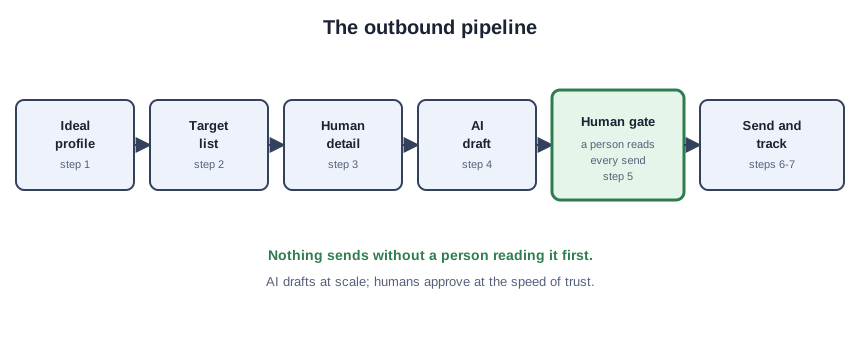
For each of the fifty rows, add one sentence a human noticed: “Opened a second plant in Dayton last spring,” “Their CEO spoke on workforce at your 2024 conference,” “Just launched a product your members asked about.” This is the step AI cannot do for you and the step that makes everything after it work: a nonprofit media publisher who landed Ford, Pepsi, and Ritz partnerships puts the failure mode plainly, saying generic pitch decks kill deals.
Step 4: Draft the outreach with AI, one prospect at a time
Now use your route’s AI. Feed it the ideal profile from step 1, the human detail from step 3, and one specific ask (a 15-minute call, not “a partnership”). Ask for a brief email — a few sentences plus the one ask — one draft per prospect, never one blast for all fifty. The rule holds: proposals do not sell sponsorship, people do, and the document confirms a conversation. Your email’s job is to start one, not to close a deal.
Route note: on Routes A and C the drafting happens on the machine, so prospect names never cross the network. On Route B, use your organizational seat, not a personal account.
Step 5: The human gate
This is the load-bearing step: a person reads every outgoing message before it sends. Check three things: is the human detail right, is the ask specific, and would you be embarrassed if this were forwarded to your board chair? Fix the draft or kill the row. AI drafts at scale; humans approve at the speed of trust. One sponsorship reference frames the economics: the sale is 20 percent of the work, and activation and fulfillment are the other 80 percent. Do not automate the part that carries your association’s name.
Step 6: Send small, track replies simply
Send ten to fifteen a week from a real person’s work email, not a marketing platform. Add columns to your spreadsheet: date sent, reply, reply date, next step. That is your CRM until volume justifies one. After four weeks, count reply rate, positive replies, and calls booked; the numbers tell you whether the step 1 profile was right.
Step 7: Stay inside CAN-SPAM
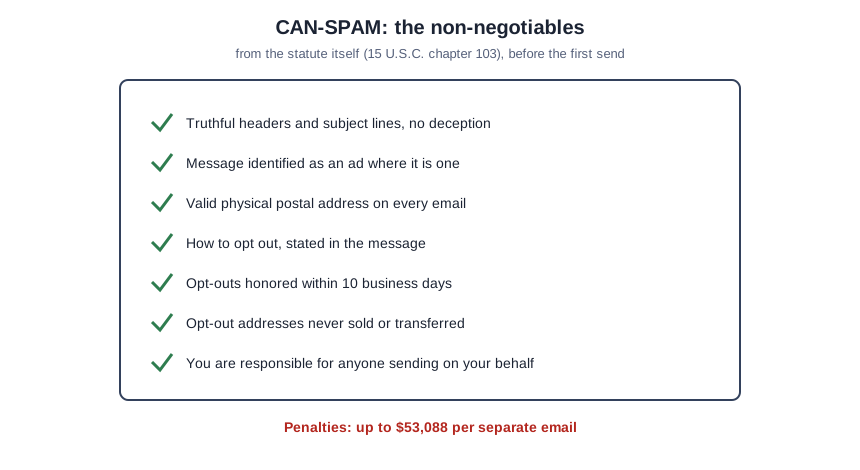
Every commercial email you send must follow the statute’s requirements — the CAN-SPAM Act itself (15 U.S.C. chapter 103) is the primary source — and the penalties run up to $53,088 per separate email under the FTC’s current inflation-adjusted maximum. The non-negotiables for this tutorial:
- No false or misleading header information, and no deceptive subject lines.
- Identify the message as an ad where it is one.
- Include your valid physical postal address on every email. Every one.
- Tell recipients how to opt out, and honor opt-out requests within 10 business days.
- Never sell or transfer the opt-out addresses.
- You are responsible for anyone sending on your behalf: the statute reaches any person acting for the sender, and businesses knowingly promoted by non-compliant mail.
Build the opt-out handling before the first send: a monitored inbox, a same-week process for removals, and a suppression list checked before every batch. “We only emailed fifty people” is not a defense.
Step 8: Run the two-minute check
After your first month, work the list:
- Did every send pass the human gate?
- Did every opt-out get honored within ten business days?
- Is the suppression list current?
- Is the reply rate telling you the profile needs adjusting?
If the compliance answers are yes, tune the profile and the drafts. If any is no, stop sending and fix it first.
The mistakes that end programs
Buying a list. It is the fastest way to get scale and the fastest way to get a penalty, a blocklisted domain, and a reputation your members hear about. Address harvesting is an aggravated violation under CAN-SPAM, and bulk email fraud carries criminal penalties. Fifty hand-built rows outperform five thousand bought ones because the fifty get replies.
Automating the send. One wrong human detail in an automated blast teaches every recipient exactly what you are.
Pitching the partnership in email one. The email asks for a conversation. The conversation earns the proposal.
Sources
- 15 U.S.C. chapter 103 — CAN-SPAM Act of 2003 (via Cornell LII): the requirements — truthful headers and subject lines, ad identification, physical postal address, opt-out honored within 10 business days, opt-out addresses never transferred; address harvesting and dictionary attacks as aggravated violations; liability reaching any person acting on the sender’s behalf.
- 18 U.S.C. § 1037 (via Cornell LII): criminal penalties for fraud in connection with electronic mail — up to five years’ imprisonment for falsified headers, unauthorized relay, and bulk falsified account registration.
- FTC: inflation-adjusted civil penalty amounts for 2025 (February 2025): maximum raised to $53,088 per violation for FTC Act §5(m)(1)(A) and (B), the provision CAN-SPAM violations are enforced under; effective January 17, 2025, and still current (no 2026 adjustment).
- ASAE: Association Operating Ratio Report FAQ: the report tracks membership dues as a share of total revenue, the benchmark behind this tutorial’s premise that non-dues revenue is structural.