Article
Shadow AI in Nonprofits Is Now Measured, and It Is a Perception Gap
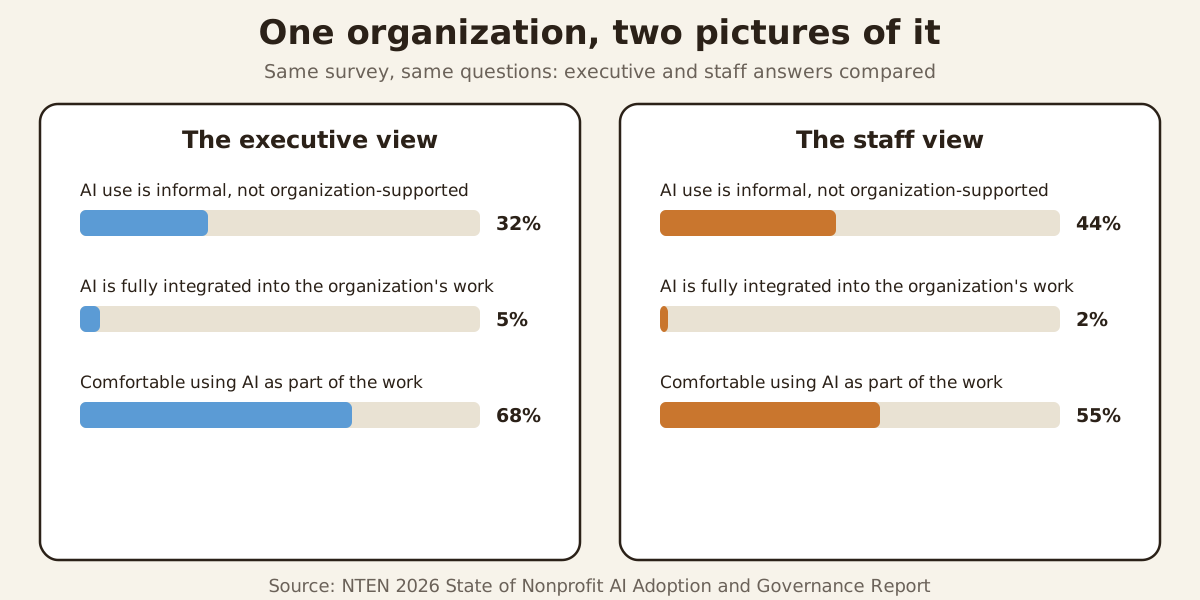
NTEN's 2026 report puts a number on shadow AI in nonprofits, 44% of staff versus 32% of executives say AI use is informal and unsupported, and the gap between those answers is the governance problem an operations lead can actually fix.
Nonprofit AI Governance Shadow AI Staff Training
Among the rank-and-file, 44% say AI is used informally by individual staff and is not organization-supported, while only 32% of executives describe the same workplace that way (NTEN’s 2026 report). Same survey, same question, and two very different answers about the same organization. Shadow AI in nonprofits is now measured, and the measurement says the biggest governance problem is not the tools. It is that leadership and staff are living in two different organizations.
The survey is NTEN’s 2026 State of Nonprofit AI Adoption and Governance Report: 917 nonprofit staff and executives surveyed between late April and mid-June 2026, 59.7% in executive roles and 40.3% in staff roles (NTEN’s 2026 report). Staff and executives were asked many of the same questions, with their answers compared directly throughout the report. We compared the two groups’ answers against each other and against the governance numbers, and the pattern holds across every section of the report.
The headline numbers on adoption are close to universal. 98% of respondents use AI in some capacity, 61% in an official one (organized pilots at 33%, team-wide use at 24%, fully integrated use at 4%), and only 2% do not use AI at all (NTEN’s 2026 report). Beneath that near-universal use sits the shadow layer: 53% of all respondents report informal, unofficial AI use outside organizational guidance, with executives engaging in it at a higher rate than staff, 57% versus 49% (NTEN’s 2026 report).
The two groups do not just use AI differently. They describe the organization differently. Executives were more likely than staff to say AI is fully integrated into the organization’s work (5% versus 2%), used across many teams or workflows (25% versus 23%), or in use within small pilot programs (35% versus 29%) (NTEN’s 2026 report). The report’s authors put it this way: “Where executives describe deliberate strategy, staff more often describe adoption as something that continues to happen to and around them, driven by external pressures or day-to-day work needs rather than being intentional, collaborative, and planned” (NTEN’s 2026 report).
The motivations diverge just as sharply. Among executives, the top reasons for adopting AI were cost reductions or efficiency increases (63%), reduction of staff burdens (62%), and quality or consistency of work (58%) (NTEN’s 2026 report). Staff cited reducing staff burdens most often too, but at a lower 48%, followed by keeping up with peers or sector trends (44%), cost or efficiency (42%), and quality or consistency (35%) (NTEN’s 2026 report). Executives also see far more untapped opportunity: 44% strongly agree their organizations have meaningful untapped AI opportunities, compared with 23% of staff (NTEN’s 2026 report). And the infrastructure to support any of this is thin: 57% of executives report no dedicated AI budget, 37% say they do not train staff on the AI tools available to them, and 58% say no AI roadmap exists, while only 8% have one in place (NTEN’s 2026 report).
What the gap costs the operations desk
For an operations lead, the danger is not any particular tool. It is running an organization where two different descriptions of reality circulate at once. The executive believes AI use is organized and mostly piloted; the staffer quietly pastes a renewal export into a personal chatbot account to draft lapsed-member emails. This is a teaching example, not a case study, but it is exactly the shape of that split. The costs land on the operations desk as unvetted tools touching member data, duplicate licenses bought by different departments, and training budgets spent on generic literacy while the actual workflows go untaught. Note the uncomfortable detail: executives report more shadow use than staff, 57% versus 49% (NTEN’s 2026 report), which means the people setting the strategy are also the people most likely to be freelancing with tools outside it. The fix is not to ban the tools, which 98% of the sector already uses (NTEN’s 2026 report). The fix is to find your own numbers and close the distance between the two pictures.
Three moves that close the distance
Run them in order.
-
Run a short anonymous staff survey to find your own informal-use number. Five questions are enough: what tools staff actually use, how often, what kinds of member data go into them, what they wish were sanctioned, and what worries them. Keep it anonymous, because staff only report unapproved tools honestly when names are off the form. Benchmark the result against NTEN’s 44% staff figure and share the number with your executive director.
-
Put a one-page acceptable-use policy in place. The sector agrees the fix is clearer guidance, and one page is enough to name approved tools, what data can and cannot enter them, and who to ask when unsure. Our guide to writing a one-page AI acceptable-use policy walks through the whole exercise, so start there rather than drafting from a blank page.
-
Train on real workflows, not generic AI literacy. Your survey will show the tasks staff already run through AI tools on their own: drafting member emails, summarizing meeting notes, segmenting lists, writing appeal copy. Train on those, with your organization’s data rules built in. A generic prompting-basics session teaches skills staff then apply to tasks nobody approved, which is how the informal-use number keeps climbing.
The sector’s own conclusion is the same: interest has outpaced infrastructure, and the agreed fix is clearer guidance and real training. Start by measuring your own gap, write the one page, and teach the workflows people are actually running. The tools were never the problem. The two different organizations were.
Sources
- NTEN, 2026 State of Nonprofit AI Adoption and Governance Report: https://www.nten.org/publications/state-of-nonprofit-ai