Article
BeginnerGive AI Its Own Line Item
Most associations run AI on no dedicated budget: the tooling is already in the building, funded by nothing and governed by nobody. Here is the board-level case for a small, concrete AI line item: team seats, local hardware, and training.
Budgeting Governance Operations
Here is a question worth bringing to the next board meeting: what is our AI budget? Walk into almost any association office and AI is already at work — drafting, summarizing, answering member questions. Ask who approved the tools, what the data terms say, and who was trained to use them, and the room goes quiet. In most organizations, AI is funded by nothing and governed by nobody: no dedicated budget, no training, no approved tool list.
This article makes one argument: give AI its own line item. Not a large one. A small, concrete one, sized to what an association actually needs: team subscriptions for the power users, optionally one machine that runs AI locally, and training money so your organization is not the one with none. The ask is modest. The alternative, which is what most associations have now, is not free. It is just unpriced.
What “no budget” actually buys
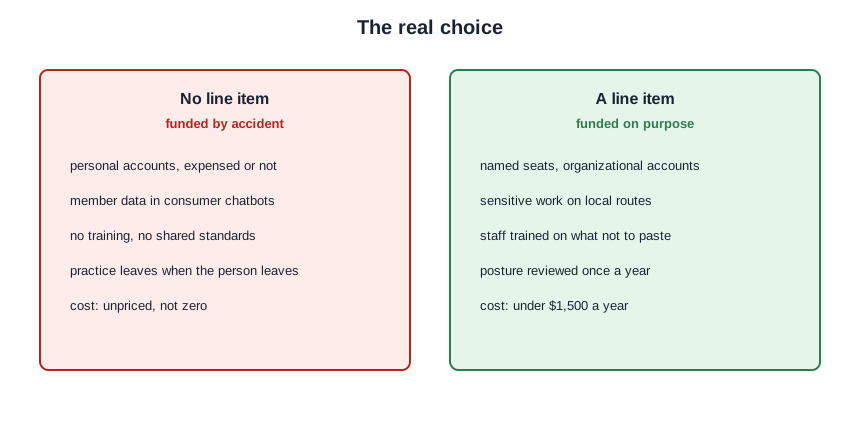
When there is no line item, spending does not stop. It goes informal. A staff member pays for a personal subscription and expenses it, or does not. Someone pastes a member list into a free consumer chatbot because the task is due at five. The communications director does genuinely useful work with tools nobody approved, on data terms nobody read. None of this appears in a budget, which is exactly why it never gets discussed, and it is where the real costs hide: member data in consumer accounts, no training, no shared standards, and every departure taking the whole practice with it because it lived in one person’s login.
A line item does not buy software. It buys the moment where the organization decides, on purpose, how AI gets used. That decision is worth more than any subscription.
What the line item contains
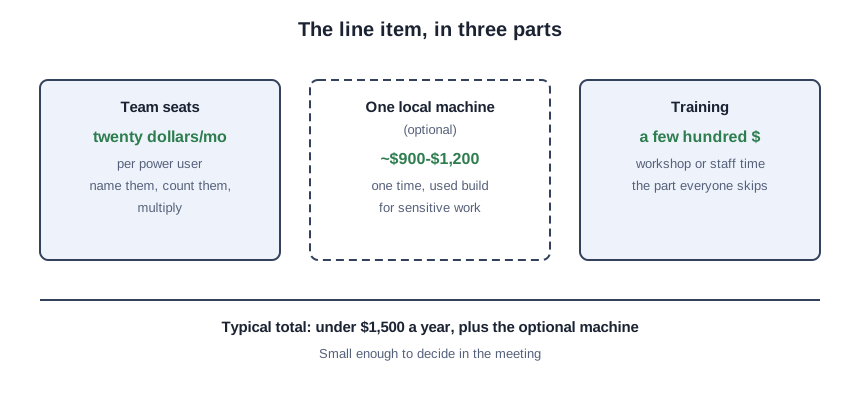
Keep it to three parts, each with a real number attached.
Team seats for the power users: about twenty dollars a month each. Our companion piece on three ways to give staff an AI assistant argues that most staff need no paid seat at all: free browser and desktop routes cover drafting and summarizing, privately, on the machine. The paid seats are for the two or three people doing the hardest thinking: research, analysis, long documents. Twenty dollars a month per seat is the current going rate for the major subscriptions. Name the people, count the seats, multiply. If you cannot name them, you do not need the seats yet.
Optionally, one local machine: on the order of a thousand dollars, once. A desktop that runs capable open models locally, with no per-query cost and no data leaving the building, is the hardware answer to the privacy question. Current used-market builds with enough video memory for this sit roughly in the $900 to $1,200 range; prices move with the used graphics-card market, so treat that as a range, not a quote. This is the right purchase for the association that handles sensitive member data and wants the strongest possible answer to “where do our prompts go.” It is optional. Many associations will never need it.
Training: the part everyone skips. Training is the cheapest item on this list, and the one most often missing. A few hundred dollars for a workshop, or staff time to run the tutorials on this site as a team exercise, turns the subscription seats from private productivity into organizational capability. An untrained staff with paid seats is just a faster version of the informal mess above.
The honest objection
The objection you will hear, and it deserves a straight answer: why not just use free tools? Free routes are real, and we recommend them for most staff. But “free” in practice has meant personal consumer accounts, which is where the member-data risk lives, and it has meant zero training. The line item is not paying for capability you could get free. It is paying for the governed version: named seats under organizational accounts, data terms someone actually read, and staff who were taught what not to paste. Free tools plus a line item is the right answer. Free tools instead of a line item is the current situation with better branding.
The board conversation
Bring three things to the meeting. First, the honest audit: no budget line, no training, no approved tools — and the question of whether this board wants that posture deliberately or by drift. Second, the actual ask, which for a typical association is under $1,500 a year plus an optional one-time machine: small enough to decide in the meeting. Third, the governance point: the line item is the moment the organization chooses its AI posture on purpose, including which data never goes into a cloud prompt box.
Boards approve what is concrete. “AI strategy” is not concrete. Three named seats, one optional machine, and a training workshop is concrete. Put it in the budget as its own line, review it once a year, and the informal sprawl above gets replaced by something the organization chose. That is the whole case.