Article
BeginnerYour Brainstorming Is Broken. Run a Tournament Instead.
Classic brainstorming suppresses the ideas it claims to want. Published experiments point to a better format: the innovation tournament.
Innovation Brainstorming Staff Development Decision Making
Your last staff brainstorming produced fourteen ideas. Eleven came from the same three people, two were the director’s restated by loyal deputies, and the one you picked was the safest. Everyone left feeling heard, which is the problem: the meeting was designed to produce agreement, not ideas.
We think associations keep running this meeting because it looks like work. A room full of people talking about a problem feels like progress. The published evidence says the format quietly suppresses the thing it claims to want.
The format fights the brain
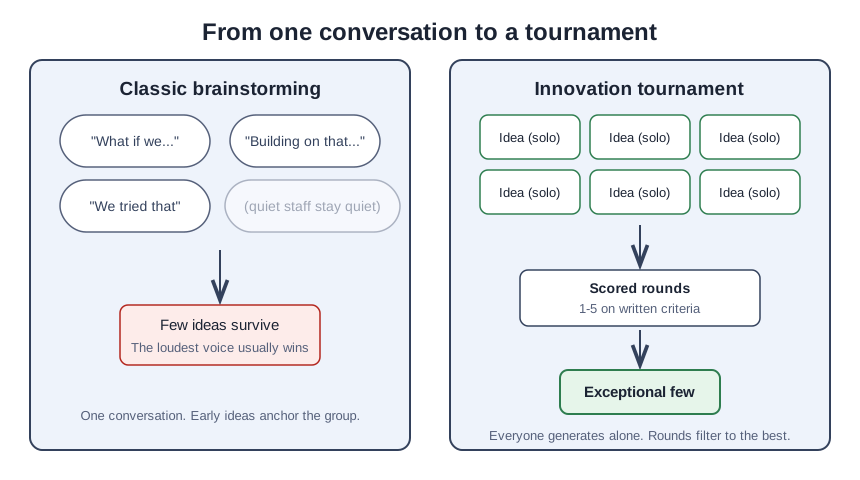
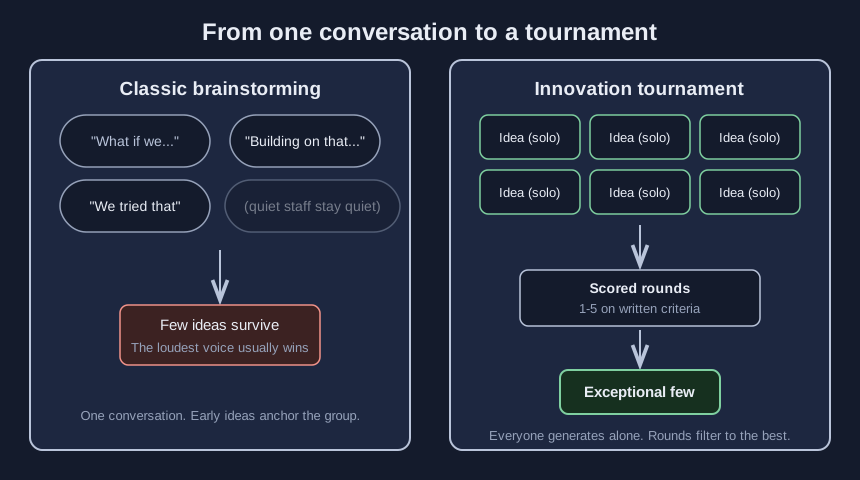
In a 2010 experiment published in Management Science, researchers compared classic group brainstorming against a hybrid: people generated ideas alone first, then brought them to the group. The hybrid groups produced about three times as many ideas, and the average quality was better by roughly thirty percentage points. The single best hybrid idea beat the best idea from the classic groups.
The mechanisms are unflattering. In a group, people self-censor, wait for a turn to speak, and converge early on the first plausible suggestion so the meeting can end. The study also tested the beloved “build on each other’s ideas” technique and found it counterproductive: buildup ideas were neither more numerous nor better. Piggybacking feels collaborative. It performs worse than silence.
What to run instead
Two Wharton professors, Christian Terwiesch and Karl Ulrich, gave the alternative a name: the innovation tournament. Their framing, summarized by Wharton, rests on three observations. Value comes from the exceptional few ideas, not the average. You cannot identify those few in advance. And you can invest a little to learn a lot, by letting many candidates enter and filtering them through rounds.
A tournament is a different social contract from a meeting. Entry is open, generation is solo, and selection is scored against written criteria instead of settled by whoever talks longest. The quiet membership coordinator who reads every lapsed-member email gets the same entry ticket as the VP. That matters more than it sounds: a 2010 study in Organization Science found that solvers on the margins of a problem’s field, people distant from its professional community, were significantly more likely to produce winning solutions. Your non-expert may be your best solver, provided the format lets them enter.
The scale argument is not theoretical. Researchers studying prize-based contests describe one posted to an open solver community: 722 signups, 122 solvers from 89 countries, 650 solutions in two weeks for a $6,000 purse. Thirty solutions beat the internal benchmarks, the best by a factor of a thousand, and none of the winning solvers had any background in the field. Volume of attempts plus diverse entrants plus a filter beats a small room of experts.
One tournament, worked through
A hospital ran an internal innovation tournament across 5,000 employees and collected more than 1,700 suggestions, from patient kiosks to a bereavement room to a prescription concierge. That is the tournament logic at association scale: a membership team of twelve cannot match those numbers, but it does not need to. Ten people generating alone for ten minutes produce more raw material than an hour of round-robin sharing, and a three-criterion scorecard (it solves the problem, our staff can do it, it fits the mission) filters faster than any debate.
This is a teaching example, not a case study: imagine your programs team framed as “how might we fill the 80 empty seats in the spring workshop series.” Ten silent minutes of writing, every idea scored 1 to 5 on those three tests, the top six pitched in two minutes each, the winner assigned an owner and a first step. The expertise your team builds is not trivia about the problem. It is the practiced skill of framing a question, generating options without anchoring, and judging them against criteria instead of charisma.
The caution the research insists on
Points are not the point. A meta-analysis of 128 experiments found that tangible extrinsic rewards reliably undermined intrinsic motivation for interesting tasks. Your staff already care about the mission; paying them in points for mission work can reduce the caring. Keep the rewards informational: recognition, a visible scoreboard, the winner’s idea actually getting built. The prize is that the work mattered.
Tournaments also have a boundary. They fit problems that are well defined but unstructured, where many approaches could work and nobody knows which. Do not tournament-ize compliance, crisis response, or anything that needs one accountable owner by Friday. And run the thing more than once: the novelty fades, and the skill compounds.
We built a game that runs this exact format so a team can try it in an hour: Problem Sprint. The companion tutorial walks through facilitating your first session, round by round.
Sources
- Girotra, Terwiesch, and Ulrich, “Idea Generation and the Quality of the Best Idea,” Management Science 56(4), 2010: hybrid solo-first generation vs. classic brainstorming; buildup counterproductive.
- Wharton, “Innovation Tournaments: Why Some Succeed and Others Fail”: the tournament’s three governing principles.
- Jeppesen and Lakhani, “Marginality and Problem-Solving Effectiveness in Broadcast Search,” Organization Science 21(5), 2010: marginal solvers and winning solutions.
- Lakhani and Boudreau, NBER/HBS working paper, 2015: the 722-solver contest, 650 solutions, 30 beating benchmarks.
- Deci, Koestner, and Ryan, “A Meta-Analytic Review of Experiments Examining the Effects of Extrinsic Rewards on Intrinsic Motivation,” Psychological Bulletin 125(6), 1999: 128 experiments on rewards undermining intrinsic motivation.
Sources (5)
- Girotra, Terwiesch, and Ulrich: Idea Generation and the Quality of the Best Idea (Management Science, 2010)
- Wharton: Innovation Tournaments — Why Some Succeed and Others Fail
- Jeppesen and Lakhani: Marginality and Problem-Solving Effectiveness in Broadcast Search (Organization Science, 2010)
- Lakhani and Boudreau: Prize-based contests and problem solving (NBER/HBS working paper, 2015)
- Deci, Koestner, and Ryan: A Meta-Analytic Review of Experiments Examining the Effects of Extrinsic Rewards on Intrinsic Motivation (Psychological Bulletin, 1999)