Article
Your Member-Facing AI Now Answers to Fifty States
State AI-disclosure laws are taking effect in 2027. Build a state-by-state inventory for your chatbot and AI-drafted content, assign one owner to the NCSL tracker, and check disclosures before every campaign.
AI Disclosure Compliance Member Communications State Legislation Operations
One chatbot, fifty rulebooks
Picture an association with members in many states. It launches two things this fall: a friendly AI chatbot answering member questions on the website, and a series of recruiting videos narrated by an AI-generated voice. The comms team adds one disclosure line to both: “Created with AI.” That feels careful. It is not.
The disclosure landscape shifted under every national launch plan. State legislators across the nation introduced over 1,000 measures on artificial intelligence in 2025, according to NCSL. In that session, all 50 states, Puerto Rico, the Virgin Islands, and Washington, D.C., introduced AI legislation, and 38 states adopted or enacted around 100 measures. Those are enacted laws, not proposals, and many of them cover exactly what your chatbot and your videos do.
September 2026 added three more in California. SB 1119, known as Adam’s Law, was approved on September 10, 2026: companion-chatbot operators face child-safety risk assessments, age assurance, and crisis-response protocols, and the statute says those duties “shall become operative on July 1, 2027,” with the first independent child safety audit due “on or before January 1, 2029.” SB 1050, approved on September 16, 2026, makes it unlawful to publish an advertisement that prominently includes an AI-generated “synthetic performer” without a clear and conspicuous disclosure, using wording substantially similar to “this performance features a synthetic performer” or “no human performer is depicted”; its official bill status lists it as a non-urgency measure, which puts it on California’s standard January 1, 2027 effective date. SB 867, also approved on September 10, 2026, prohibits the manufacture or sale of toys that include a companion chatbot until January 1, 2031, as a non-urgency measure effective January 1, 2027.
Why the single disclosure line breaks
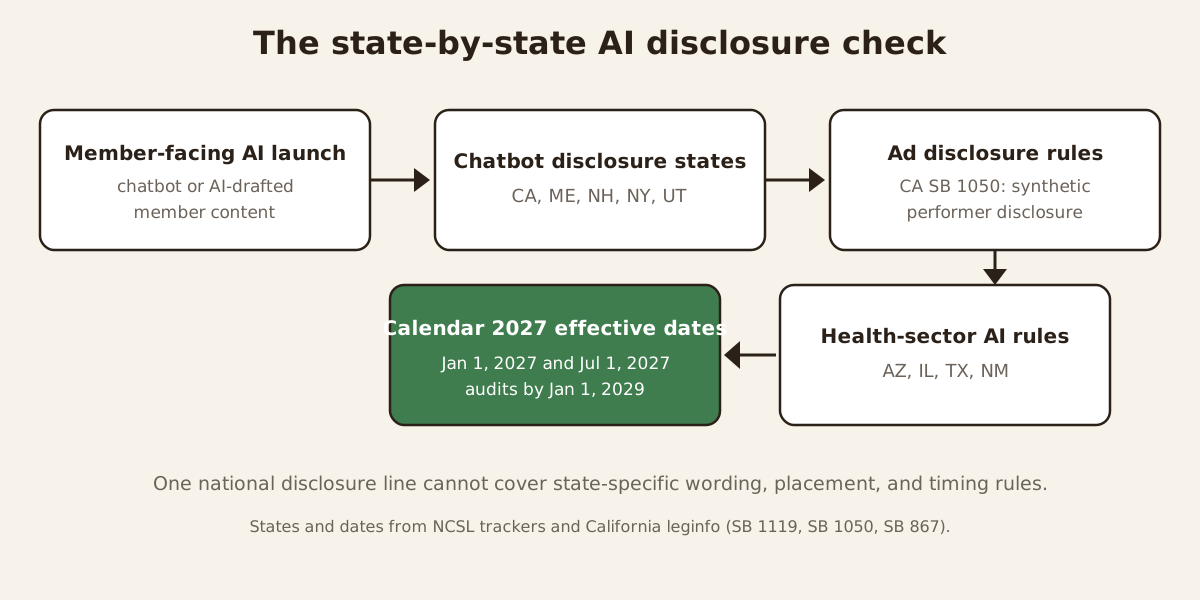
A national disclosure line fails because states wrote different rules for different uses. California’s SB 243 already requires minors to be told they are interacting with AI. Maine (HB 1154) requires disclosure of AI use in commercial chatbot interactions, Utah (SB 226) requires disclosures when generative AI is used in consumer transactions, and New York (SB 3008) sets requirements and prohibitions for AI companions. Health settings drew their own wave: Arizona (HB 2175) bars AI from denying medical claims, Illinois (HB 1806) restricts AI in therapy, Texas (SB 1188) requires providers to review AI-generated records, and New Mexico (HB 178) directed its nursing board to write AI rules. Your one line was written for your comfort, not for their wording, placement, timing, and audience rules. The wrong disclosure in the wrong state is no disclosure at all.
Texas added its own twist: HB 149 requires specific disclosures of AI use and bars developers from building systems designed to make discriminatory decisions or incite self-harm. Each state is writing its own definition of what honest AI use looks like.
The other shortcut is waiting for Congress to harmonize everything. We looked for a single federal disclosure rule covering member-facing chatbots and AI-generated ads, and did not find one. The regulators in this picture are the states, and they are not waiting.
Build the inventory, name the owner, check the checklist
The fix has three parts, all boring, all cheap.
First, build a state-by-state AI disclosure inventory for every member-facing AI you run. Each row names a state where your members live, the AI use (chatbot, AI-narrated video, AI-drafted email), the rule that applies, the exact wording the rule demands, where the wording must appear, and the date the rule takes effect. Start from NCSL’s trackers, then read the bill text for the states you actually reach. One association found its footer line satisfied no one: Maine wants commercial-chatbot disclosure, Utah wants consumer-transaction disclosure, California’s new ad law wants specific performer wording. The inventory is a spreadsheet, not a legal opinion. Run it past counsel before it governs anything.
Second, assign one person the NCSL tracker every quarter. AI laws arrive monthly now; September alone brought three California measures with 2027 dates. One name owns the check, and the check happens on a schedule whether or not anyone feels like it.
Prioritize the inventory by exposure. The chatbot goes first: California’s minor-disclosure duty is already live, and the 2025 chatbot laws in Maine, Utah, and New York are on the books. Then the ads: any campaign using an AI-generated face or voice gets the synthetic-performer check before media is bought. Uses that only touch internal drafts can wait for the next quarter.
Third, add AI-disclosure review to the comms checklist before campaigns launch. Your campaign briefs already cover brand voice, proofing, and approvals. Add one more line: which states does this reach, and what does the inventory say about the AI in it? The check takes minutes when the inventory exists. Without the inventory, nobody does it.
A worked example: the recruiting video rollout
This is a teaching example, not a case study. A national trade group for independent insurance agencies launches AI-narrated recruiting videos on social media and keeps a member FAQ chatbot on its site. The comms team uses one disclosure line for both, everywhere.
The inventory catches three problems. The videos run in California, where SB 1050 requires specific disclosure wording for AI-generated synthetic performers starting January 1, 2027; the team’s generic line does not match the statute’s required phrasing. The chatbot serves members in Maine and Utah, where commercial-chatbot and consumer-transaction disclosures follow state-specific rules the footer line was never written to meet. And the chatbot answers questions from minors in California, where disclosure duties to young users already apply under SB 243.
The fix follows the three parts. They rewrite the disclosures state by state in the inventory, they put one name on the quarterly NCSL check, and they add the disclosure line to the campaign brief template. Nothing about the AI changes. Everything about the paperwork does.
Calendar 2027 now
The dates are the reason to move now. California’s toy-chatbot prohibition and synthetic-performer ad disclosures take effect January 1, 2027. The companion-chatbot safety duties become operative July 1, 2027, and the first independent audits land on or before January 1, 2029. Put each date on the calendar with a reminder one quarter out, because compliance work done in December is panic and compliance work done in October is a project. Attach the inventory review to the same reminder, so the dates never age without the person checking them.
One last caution about the numbers. Legislators introduced over 1,000 AI measures in 2025, but 38 states enacted around 100. A thousand bills introduced is not a thousand laws. Introduced bills are noise; enrolled chapters are the signal. Track what passed, calendar what passed, and the state-by-state patchwork becomes manageable.
Sources
- NCSL: New Trends Emerge as States Refine AI Legislation (State Legislatures News, Jan 22, 2026)
- NCSL: Artificial Intelligence 2025 Legislation
- California SB 1119 (Adam's Law), Chapter 190, Statutes of 2026, official bill text
- California SB 1050 (synthetic performers), Chapter 246, Statutes of 2026, official bill text
- California SB 867 (toys: companion chatbots), Chapter 189, Statutes of 2026, official bill text