Tutorial
BeginnerRun a Problem Sprint in 60 Minutes
A timed, scored team game that turns one real problem into ranked solutions and an owner. Play it in your browser, then run it at your next staff meeting.
Time needed: About 60 minutes with a team, 30 alone
Before you start:
- One real problem your team owns, framed as a question
- Two or more colleagues in a room, or just yourself and a quiet hour
- A browser. Nothing to install, nothing uploads
Facilitation Innovation Teamwork Scoring
By the end of this tutorial you will have run a timed, scored problem-solving session on one real problem, ranked the solutions against written criteria, and left with a named owner and a first step.
Try it now: Problem Sprint is the game this tutorial teaches. It runs the timer, keeps the score, and exports your summary, entirely in your browser. Your problem and ideas never leave the tab.
Why a game, and why these rules
The format is a small innovation tournament: solo generation first, then silent improvement, then scored filtering. The silence is the mechanism. A meta-analysis of serious games found that players in groups learned more than solo players, but only when the game was paired with instruction and debrief rather than left to stand alone. Another meta-analysis of gamified learning found that team-against-team designs outperformed pure individual competition, and that gamification improved cognitive outcomes with an effect size the authors called substantial. Points alone do not teach; structured rounds with a debrief do.
The debrief deserves emphasis. In the famous Beer Distribution Game, MIT’s John Sterman showed that players systematically generate wild cost swings because they misread feedback delays, and the expertise is built in the post-game reveal, not during play. Your sprint works the same way: the rounds produce the material, the last ten minutes produce the learning.
Run it in seven steps
- Write the problem as a “How might we” question. One sentence, on the setup screen. “How might we get 200 lapsed members to rejoin before March” beats “membership is down.” If the question has no number and no date, rewrite it until it does.
- Choose solo or teams and start the clock. In team mode, enter two to four team names. Mixed teams beat departments: put the membership coordinator with the events person. The person closest to the problem’s pain is not always the expert on its solution.
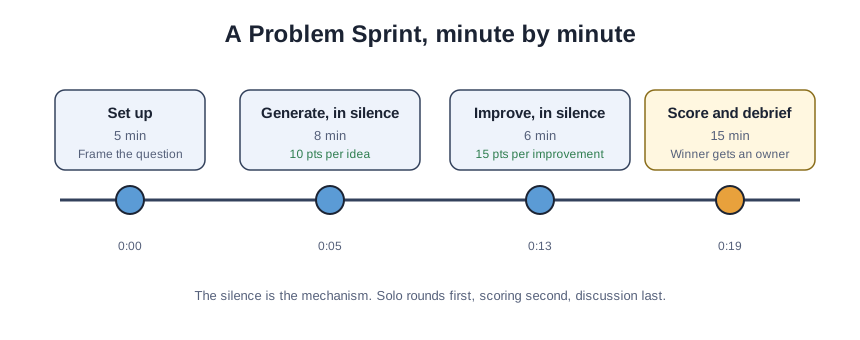
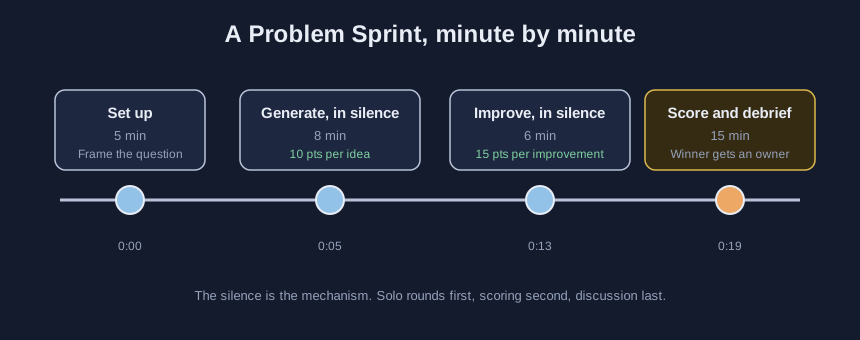
- Generate in silence for the full round. Everyone writes ideas alone, no talking, no reacting. Each idea is worth 10 points, and quantity is the goal. The game keeps score; you keep the room quiet. This is the step most teams want to skip, and it is the step the format depends on.
- Improve in silence. Pick any idea, yours or anyone’s, and write a concrete improved version: who does it, what it costs, how you will know it worked. Fifteen points each. Still no discussion. You are elaborating, not debating.
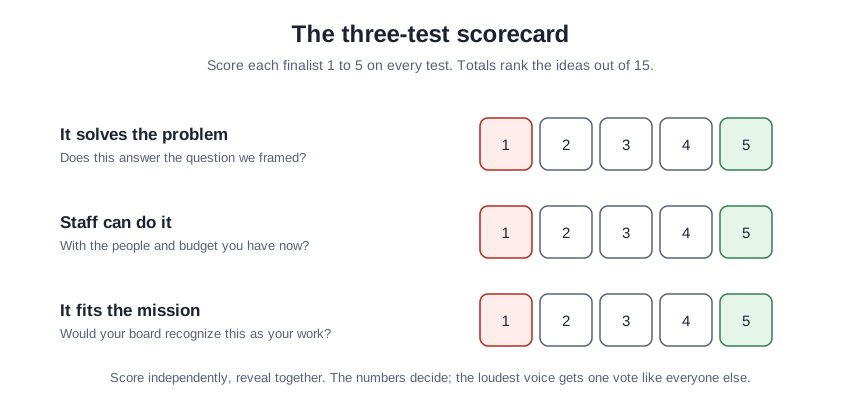
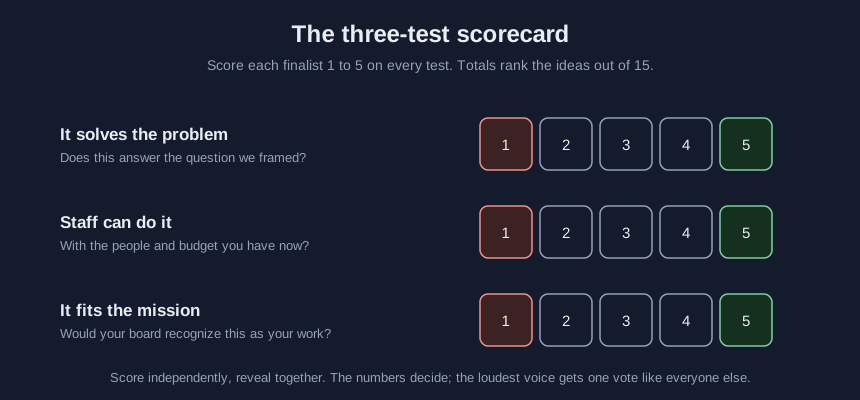
- Score every finalist on the three tests. Each idea gets 1 to 5 on whether it solves the problem, whether your staff can do it, and whether it fits the mission. Score independently first, then compare. The numbers are the decision; the loudest voice does not get a vote beyond its own scores.
- Debrief for ten minutes with three questions. The game shows these at the end: which idea surprised you and what does that say about what the team already knew, what the scoring revealed that the brainstorming hid, and who owns the winning idea next week with what first step. Do not skip this. The serious-games research is explicit that the game plus debrief beats the game alone.
- Export the summary and name the owner. Copy the game’s summary into your notes or the board packet. Assign one owner and one first step before anyone stands up. A sprint with no owner is a meeting with a scoreboard.
A teaching example: the lapsed-member sprint
This is a teaching example, not a case study. A fictional 4,000-member state association for dental hygienists has 600 lapsed members and a March renewal deadline. The membership director frames the question: “How might we get 200 lapsed members to rejoin before March 31?”
Round 1 produces 31 ideas in eight minutes from six staff. The quietest person in the room, the certification coordinator, writes: “Call the 40 lapsed members who completed CE last year but did not renew; offer the renewal plus a free webinar seat.” Round 2 turns it into: “Priya from membership calls the 40 CE-completers by February 15, offers renewal plus the March infection-control webinar (marginal cost: zero, it runs anyway); success is 12 rejoining.”
Round 3 scores it 5, 5, 4: it directly answers the question, one staffer can do it in a week, and it fits the education mission. Total 14 of 15, the winner. The director’s opening suggestion, a dues discount, scores 3, 4, 2: it might work, anyone can do it, but it trains members to wait for discounts. The numbers settle what the debate would not.
Check the result
- Your exported summary should name the problem, list every idea with its team, show the improvements, rank the finalists with scores out of 15, and name a winner.
- Count the ideas from Round 1. Fewer than three per person means the room was not actually silent, or the question was too vague.
- The winning idea should have an owner and a first step with a date. If it does not, the sprint is not finished.
- Ask the quietest participant which idea surprised them. If they have no answer, the debrief was rushed.
Five ways to run a sprint that teaches nothing
Letting the director speak first anchors the room. The first idea sets the range, and everything after it is a variation. The facilitator frames the question and then writes silently like everyone else.
Skipping the silence to save time removes the mechanism. Ten minutes of quiet writing outperforms an hour of discussion; a sprint without silence is just a meeting with a timer.
Scoring by show of hands reintroduces the loudest voice. Hands follow the confident person. Independent 1-to-5 scores on the written tests, revealed together, do not.
Ending without an owner produces a ranked list that nobody acts on. The last question, who owns it and what is the first step, is the whole return on the hour.
Treating the points as the prize teaches gaming the system. Celebrate the winning idea getting built, not the high score. The scoreboard is scaffolding; the built solution is the building.
What the Problem Sprint kit contains
The kit holds a printable facilitator guide with the session script and timing, the three-test scoring sheet, and round cards you can put on the table. The download is free once you add your email to the form at the end of the game.
Sources
- Wouters et al., “A Meta-Analysis of the Cognitive and Motivational Effects of Serious Games,” Journal of Educational Psychology 105(2), 2013: groups beat solo players; games work best supplemented with instruction and debrief.
- Sailer and Homner, “The Gamification of Learning: a Meta-analysis,” Educational Psychology Review 32, 2020: team-against-team designs outperform; cognitive gains from gamified learning.
- Sterman, “Modeling Managerial Behavior,” Management Science 35(3), 1989: the Beer Distribution Game and the debrief as the site of learning.
Sources (3)
- Wouters, van Nimwegen, van Oostendorp, and van der Spek: A Meta-Analysis of the Cognitive and Motivational Effects of Serious Games (Journal of Educational Psychology, 2013)
- Sailer and Homner: The Gamification of Learning — a Meta-analysis (Educational Psychology Review, 2020)
- Sterman: Modeling Managerial Behavior — Misperceptions of Feedback in a Dynamic Decision Making Experiment (Management Science, 1989)