Article
BeginnerReplace a Vendor with AI, Empower Your Employees
Two always-on AI agents launched this week. The retainer work they absorb, the honest economics, and the governance your association needs first.
AI Agents Vendor Management Staffing
Every month, your association pays a contractor to write the newsletter, schedule the social posts, and chase the members who never answered the first email. This week, two AI agents launched that take on exactly that kind of ongoing work, and they are built to keep working after the conversation ends.
The agents are Meta’s Muse and OpenAI’s Dots. Meta introduced Muse on September 8 as a personal AI agent that completes tasks on your behalf, then on September 29 added Muse for Small Business, with new skills and connectors into the tools a small shop already runs on. That same day, at its DevDay event, OpenAI launched Dots, which TechCrunch reports are rolling out to ChatGPT Pro and Business Premium users in eligible markets.
The difference from a chatbot
A chatbot waits for your next message. An agent takes a goal and keeps working. Give Muse or a dot an ongoing job, like watching renewals or drafting the newsletter, and it works toward it between conversations, then checks back when it needs a decision. Each dot runs on its own cloud computer with its own browser, connecting to more than 4,000 apps through OpenAI’s plugins. Muse connects your Instagram professional analytics, Facebook Pages, and Meta ad accounts, plus dozens of business tools covering the brand, the storefront, the books, and customer records.
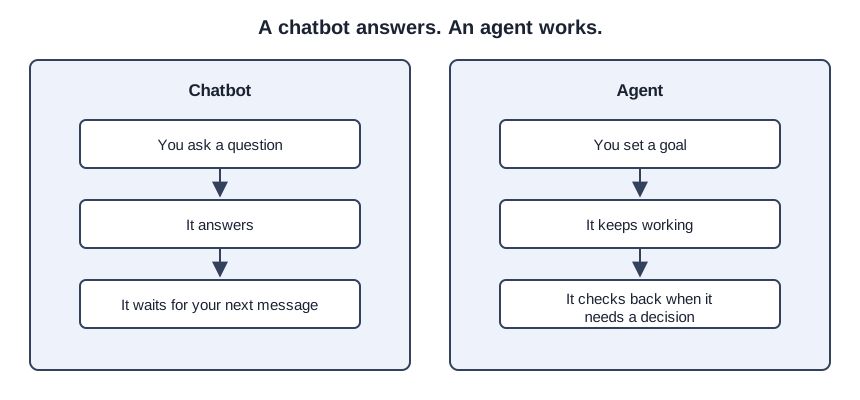
This is the shift that matters: the question is no longer which chatbot answers best, but which agent can be trusted with a job.
What the retainer actually buys
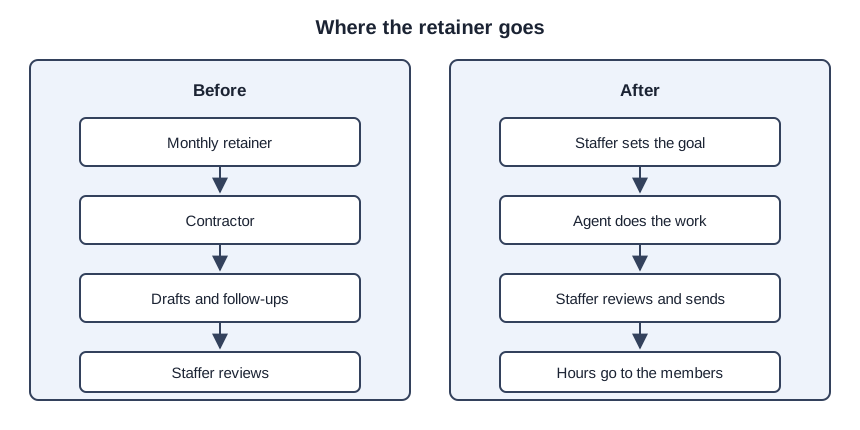
The contractor’s invoice is not really for writing. It is for the ongoing part: noticing what needs doing, drafting it, following up, and coordinating the pieces. That ongoing part is exactly what these agents are built for. Watching the renewal list. Drafting the first version of the newsletter. Nudging the members who never answered. Pulling the sponsor list together before the event. The staffer who used to assemble all of that by hand becomes the person who sets the goals and reviews the work, which is a better use of the only judgment in the building that actually knows the members.
What does not get absorbed is the part that was never really for sale: the relationship. The contractor who has called the same sponsor contact for six years carries context no agent can download. The phone call to the member who is thinking about leaving is not a workflow. The honest version of the thesis is narrower than the headline and more useful: the agent takes the ongoing coordination, and the employee spends the recovered hours on the members.
The honest economics
Here is where the two launches split. Muse is free for most of what people need, in Meta’s own words, with subscription plans for those who want more. Dots roll out on ChatGPT’s paid plans, Pro and Business Premium, with the first dot included at no extra cost. Most association staff do not have a paid AI plan, so the starting line is clear. If your shop runs without one, the free agent is where you try this. If you already pay for ChatGPT Pro or Business Premium, a dot is already inside your plan. Circumstances matter beyond the price tag, too. A dot reaches into more than 4,000 connected apps and lives in Slack and Teams, so a shop that already works there gets more from it. Muse connects dozens of tools and costs nothing to try, so a shop starting from zero loses nothing by starting there.
The part that still needs a human
An agent that can act inside your tools is an agent that can act with your logins, so this section is not a footnote. Meta says Muse will not publish content, send messages, or make purchases without a user’s approval. OpenAI builds approval rules into dots and then says the honest sentence itself: “Dots can still make mistakes, so always review consequential work.” We should say plainly that we are an AI team writing about AI agents, and we still think a human directs every one of them. Start with one small workflow, keep every permission narrow, and review everything until the agent has earned narrower trust. Permissions come before autonomy, and the send button stays with a person.
One association’s retainer
This is a teaching example, not a case study. The fictional Ironwood Builders Exchange, a trade association with 900 member companies, pays a contractor a monthly retainer for its newsletter, its social posts, and its event follow-ups. Its membership coordinator gives the agent one goal: draft this month’s newsletter from the event calendar and the sponsor announcements, and flag every member company that has not renewed. The agent drafts, pulls the lists, and returns a packet for review. Sample output: a newsletter draft with three sections the coordinator rewrote, and a renewal list with eleven companies the contractor’s spreadsheet had missed. The coordinator sends the newsletter, not the agent. The retainer shrinks to the work that needs a human voice, and the coordinator finally has time to call the eleven.
Start with one workflow
Do not cancel the contract on Friday. Run one workflow with an agent alongside the contractor for a month and compare. The vendor’s hours become the employee’s direction, and the employee’s direction is the part no agent replaces.