Article
BeginnerEngagement Before Revenue? What the Published Evidence Supports
Published studies link member engagement to retention and advocacy. None of the six documents we read shows it raising dues or sponsorship revenue.
Engagement Retention Revenue Research Board
A board member asks the question every membership director eventually hears: if we spend this year on engagement, will the revenue follow? The most careful published answer we found is a qualified maybe, and it starts with ASAE Foundation’s summary of its membership research, which says involved members become advocates when their experiences are positive.
That is a finding about goodwill, not money, and the summary is thin on evidence: its four pages contain no percentages, no sample sizes and no revenue figures. So we read five more documents to see what sits behind the claim that engagement comes first.
What the studies link to engagement
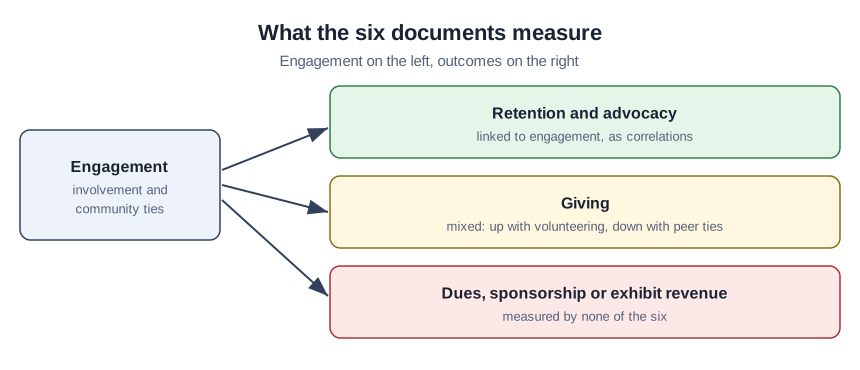
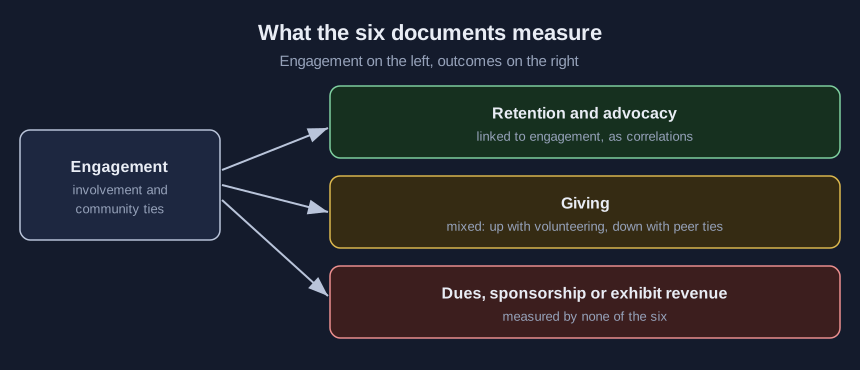
The one study of association records we found, a 2005 analysis of 1,441 member records from a single professional organization, reports a positive correlation between involvement and staying a member. Its author adds that correlation is not causation. We would add that involved members may simply be the ones who were already committed.
Outside associations the pattern repeats. A University of Maryland report found that people who volunteered in the previous year were 14.5 percentage points more likely to give in the current year, and its author warns that simple correlations cannot settle which way the effect runs. That is individual charitable giving, not dues.
Where the evidence cuts the other way
A peer-reviewed study of one nonprofit zoo’s members found that identifying with the organization raised donations while identifying with fellow members lowered them. For retention the same study found that peer ties matter more to members of eight years or longer. Community can help one outcome and cost another.
Revenue can also move while the number of donors moves the other way. The Fundraising Effectiveness Project estimates that donor counts fell 3.6 percent in 2025 while dollars rose 5.0 percent, with growth driven almost entirely by major and supersize donors. On the association side, ASAE’s April 2025 insight update reported that half of responding CEOs saw lower meeting attendance while speaker, exhibitor and sponsor participation stayed relatively stable, in a poll with 210 responses analyzed.
What none of the six documents tests
None of them tests whether an engagement program raised dues, sponsorship or exhibit revenue, and none compares the same members before and after a program or against a group left out of it. We think the honest summary is narrow: engagement is linked to staying and speaking well of an association, and its effect on revenue is a hypothesis the published record has not tested. A vendor deck that treats the revenue effect as settled is claiming more than these documents show.
Test it in your own records
This section is our own suggestion, not a finding from any of the six documents. It needs no new software, only an export from your AMS or a spreadsheet.
Before you look at any results, write down three things: the one activity you are testing (a committee, an event series or a webinar track), the outcome you will count (renewed or did not renew by the end of your grace period), and the dates you will cover. Choosing these first keeps you from picking whichever comparison happens to look best afterward.
Then build one table with a row per member. Add a yes or no column for taking part before the renewal notice went out, the member’s dues category, years of membership, and a renewed column. Compare renewal rates only inside the same dues category and tenure band, so a first-year member is never set against a long-time one.
Count only participation that happened before the renewal notice. Someone who joins a committee after renewing says nothing about whether involvement came first.
If the gap is small, or disappears inside the bands, tell the board exactly that. A table like this can show a pattern among your members, and it cannot show that the program caused it.
Three moves for a membership desk
- Report retention and revenue as separate lines to the board, so the supported claim is never used to carry the unsupported one.
- Run the check from the section above on one engagement activity before asking for a larger budget, and read any gap as a lead, not proof.
- Ask sponsors what they value before reading an attendance dip as a sponsor problem, because the ASAE poll found the two moving apart. If they want engagement numbers, Monetize Your Own Retargeting Audience covers what you can show them.
Sources
- ASAE Foundation, “7 Drivers of Membership” (2015): involved members become advocates when experiences are positive; the four-page summary has no percentages, sample sizes or revenue figures.
- Nathan Dietz, “Social Connectedness and Generosity,” University of Maryland Do Good Institute (January 2024): volunteering and giving linked by 14.5 percentage points; the author warns correlations cannot settle causality.
- Fang, Fombelle and Bolton, “Member Retention and Donations in Nonprofit Service Organizations,” Journal of Service Research (2020): organizational identification raised donations, peer identification lowered them; peer ties mattered more for retention at eight years or longer; one nonprofit zoo.
- Fundraising Effectiveness Project, 2025 Q4 report: donors down 3.6 percent, dollars up 5.0 percent, growth driven almost entirely by major and supersize donors.
- J. M. White, Journal of Applied Communications (2005): positive correlation between involvement and retention in 1,441 member records of one organization; correlation is not causation.
- ASAE, insight update news release (April 23, 2025): attendance down for half of responding CEOs while speaker, exhibitor and sponsor participation stayed relatively stable; 210 responses analyzed.
Sources (6)
- ASAE Foundation: 7 Drivers of Membership (2015)
- University of Maryland Do Good Institute: Social Connectedness and Generosity (Nathan Dietz, January 2024)
- Fang, Fombelle, and Bolton: Member Retention and Donations in Nonprofit Service Organizations (Journal of Service Research, 2020)
- Fundraising Effectiveness Project: 2025 Q4 report
- White: Influence of Involvement, Institutional Affiliation, and Geographic Location on Membership Retention (Journal of Applied Communications, 2005)
- ASAE: ASAE Insight Update Reveals Shifting Meeting Attendance Trends Amid Federal Policy Changes (April 23, 2025)