Article
BeginnerDoes AI Actually Save Staff Time? What Was Measured and What People Reported
Reported time savings from AI run well ahead of what timed tests and payroll records show. None of the six documents we read measured association staff.
Time Savings Measurement AI Pilot Research Board
Your executive team is deciding whether to keep paying for the AI tools, and the case for renewal rests on one claim: that they save staff time. If the only evidence on hand is what people have said in the hallway, the published research suggests that evidence is weaker than it feels.
The nearest thing to an association benchmark is ASAE’s March 2026 news release, in which a member association summarizes its own pulse polls of the sector. It says AI use is widespread, 87.5 percent for content and 44.3 percent for data, which counts use and not time saved. The release does not say how many organizations answered, and we read only the release, not the full report.
The figure that gets quoted is what people said
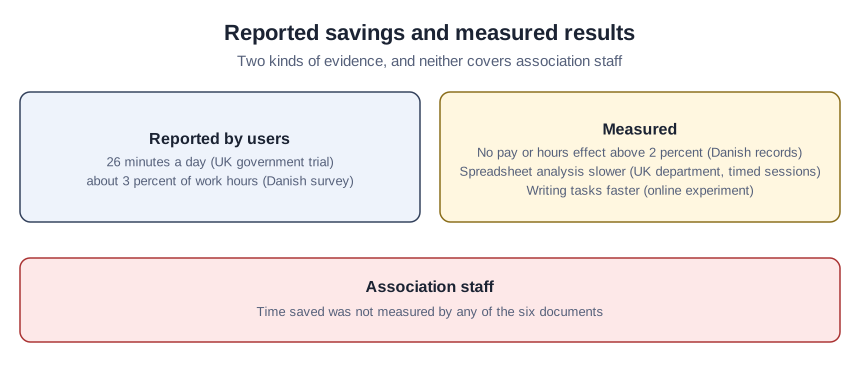
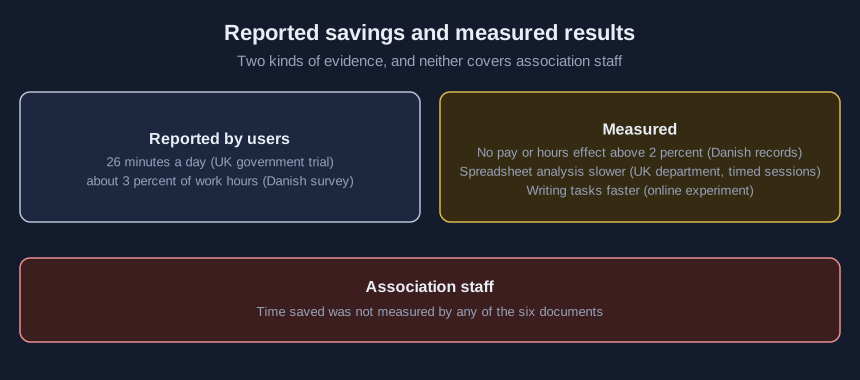
The largest trial among the documents we read is described in a UK Government Digital Service report, a government report on a three-month trial in which 20,000 government employees received a commercial AI assistant. The report says participants saved an average of 26 minutes a day, and only 17 percent of users noticed no clear time savings. Users reported that figure themselves, though, and the report adds that the trial could not identify how the saved time was spent. Its estimate of 13 working days a year is an extrapolation built from the midpoint of each answer range.
An NBER working paper, not peer reviewed, by Humlum of the University of Chicago Booth School of Business and NBER and Vestergaard of the University of Copenhagen, covers Danish workers in 11 occupations. Its latest survey round, run with Statistics Denmark in late 2024 and answered by 25,000 workers across 7,000 workplaces, was linked to administrative records of earnings and hours through December 2024. Adopters report savings of about 3 percent of their work hours, a figure the authors build from self-reported answer ranges that they coded themselves. Yet the authors rule out effects on earnings or recorded hours larger than 2 percent. We read that as a reminder that time a person feels they saved and a change in a paycheck or a schedule are different things. The paper says the linked records let it move beyond self-reported effects, and it finds employer policies that encourage use are associated with greater regular use and higher reported benefits among users, a finding that again rests on survey answers. It covers Danish workers, not association staff.
When a stopwatch disagreed with the diary
The closest check on self-reports is a UK Department for Business and Trade evaluation, a government department’s report on its own pilot with 1,000 licences. Its diary study had a 32 percent response rate, and the department added timed task sessions to address concerns about self-reported bias. In those sessions users summarized reports and wrote emails faster, though the email difference was extremely small, and they did spreadsheet data analysis more slowly and to a worse quality than non-users, which conflicted with their diary entries. On the other tasks the timed sessions somewhat mirrored the diary, so the report does not say the diaries were wrong across the board.
The same report calls its timed results limited by small samples and says the evaluation found no evidence that time savings led to improved productivity. It also found that some tasks, such as scheduling and generating images, took longer with the tool. These are findings from one government department, and they show how a diary and a clock can disagree, not how often. We do not read any of this as proof that staff are exaggerating.
Where measured gains were found, and for whom
Two journal articles found real gains in narrower settings. The abstract of a Science article by two authors in MIT’s Department of Economics reports a preregistered online experiment in which 453 college-educated professionals were assigned occupation-specific writing tasks. It reports that the average time taken decreased by 40 percent and output quality rose by 18 percent. A Quarterly Journal of Economics article by economists at Stanford, MIT and the National Bureau of Economic Research studied 5,172 customer support agents at one company, with an AI rollout that mainly ran in fall 2020 and winter 2021. It reports a 15 percent average gain in issues resolved per hour and a 30 percent gain for less skilled and less experienced workers, while the most experienced and highest-skilled workers saw small gains in speed and small declines in quality.
Five of the six documents cover other kinds of workers, and the sixth covers associations but counts use. None measures association staff. The Science article appeared in July 2023, the support rollout ran in 2020 and 2021, the Danish survey was fielded in late 2024 and the department pilot ran in late 2024, so none of them shows whether the results hold today.
Timing one task in your own shop
None of the six documents proposes what follows. It is our suggestion, and all it needs is a clock and a spreadsheet. The baseline, goal and stop rule are covered in Run Your First AI Pilot on One Workflow in Two Weeks, so this adds only the time check.
Pick one recurring task that staff already do with AI, and write down your guess at the time saved before anyone measures. Then time the task start to finish, from opening the file to a version a colleague would accept, counting the editing and checking. Ask someone other than the drafter to rate the result, and write down what the saved time will be used for, since the government trial could not say. Run the same task by hand once as a comparison. Repeat the timing over several runs, because one run mostly measures that day, and keep the guess, the clock and the quality rating in one table.
This is a teaching example, not a case study. A membership coordinator drafts the monthly renewal reminder with AI help and times the draft each month. The coordinator then compares those times with the guess made in advance. If the clock and the guess agree, the claim is safe to repeat. If they differ, the gap is the finding.
A fair answer for the board
The honest answer today is that AI can save time on some tasks, can cost time on others, and has not been measured for association staff. If the board wants a number, give it one task and one range with the dates beside it, name who rated the quality, and widen the claim only when your own clock supports it.
Sources
- ASAE, news release on the State of Associations report (March 23, 2026): AI use of 87.5 percent for content and 44.3 percent for data; release only, full report not read.
- UK Government Digital Service, cross-government findings report (2025): 20,000 government employees, 26 minutes a day reported, 17 percent noticed none, 13 days a year extrapolated, time use not identified.
- UK Department for Business and Trade, evaluation of its pilot (August 2025): 1,000 licences, diary study at 32 percent response, timed sessions, small samples.
- Humlum and Vestergaard, NBER Working Paper 33777, revised March 2026 (NBER working paper, not peer reviewed): 25,000 Danish workers in 11 occupations, about 3 percent of work hours self-reported, no effect above 2 percent on earnings or hours, encouragement linked to use.
- Noy and Zhang, Science (13 July 2023, journal article): abstract only, 453 professionals in an online writing experiment, time down 40 percent, quality up 18 percent.
- Brynjolfsson, Li and Raymond, The Quarterly Journal of Economics (May 2025, journal article): 5,172 customer support agents at one company, 15 percent average gain, 30 percent for less skilled and less experienced workers.
Sources (6)
- ASAE: ASAE Releases First-Ever State of Associations Report (news release, March 23, 2026)
- UK Government Digital Service: cross-government findings report on a trial of an AI assistant (2025)
- UK Department for Business and Trade: evaluation of its pilot of an AI assistant (August 2025)
- Humlum and Vestergaard: Still Waters, Rapid Currents: Early Labor Market Transformation under Generative AI (NBER Working Paper 33777, May 2025, revised March 2026; NBER working paper, not peer reviewed)
- Noy and Zhang: Experimental evidence on the productivity effects of generative artificial intelligence (Science, vol. 381, pp. 187-192, 13 July 2023; journal article)
- Brynjolfsson, Li and Raymond: Generative AI at Work (The Quarterly Journal of Economics, vol. 140, issue 2, pp. 889-942, May 2025; journal article)