Tutorial
Turn a Bill Into a Member Alert With AI, Without Inventing the Law
Turn a bill into a plain-language member alert with AI help: official text, version check, extraction without editorializing, line-by-line verification, named sign-off.
Time needed: About 90 minutes the first time; faster with the prompt saved
Before you start:
- The bill you need to summarize, or its number and jurisdiction
- An approved AI tool and your association's usage rules
- The name of the colleague who approves advocacy copy before it sends
Legislation Advocacy Communications Association staff
By the end of this tutorial you will turn a bill into a plain-language member alert with AI help: pull the official text, check the version, extract without editorializing, verify every line, and get a named sign-off.
State legislatures take up AI bills every session: no communications team reads every bill by hand. Members hunt for it too: GPO reported 357 million GovInfo retrievals of congressional bills in 2024, up 210 percent; link it.
Stage 1: start from the official text
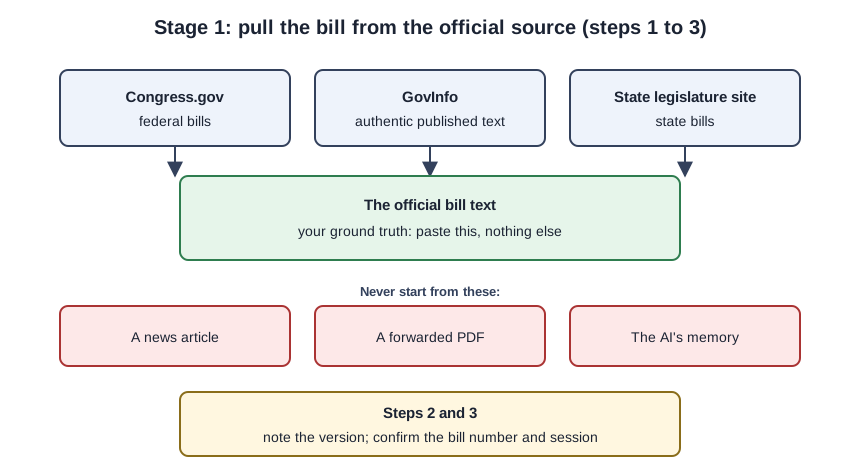
- Pull the bill from the official source. For a federal bill that means Congress.gov or GovInfo; for a state bill, the legislature’s own site. Never start from a news article, a forwarded PDF, or the model’s memory of the bill. The Government Publishing Office calls GovInfo “the one-stop site for authentic, published information for all three branches of the Federal Government.”
- Write down the version you are reading. Bills are amended as they advance; a summary of the introduced version goes stale without warning. The Library of Congress notes that in the 119th Congress, CRS summarizes introduced versions only, not later versions as measures advance, so even the official summary can lag the bill.
- Confirm the bill number and the session before you summarize. Companion bills and reintroductions from prior sessions share titles; the model will summarize the wrong one if you hand it a name instead of a number.
Stage 2: draft by extraction
-
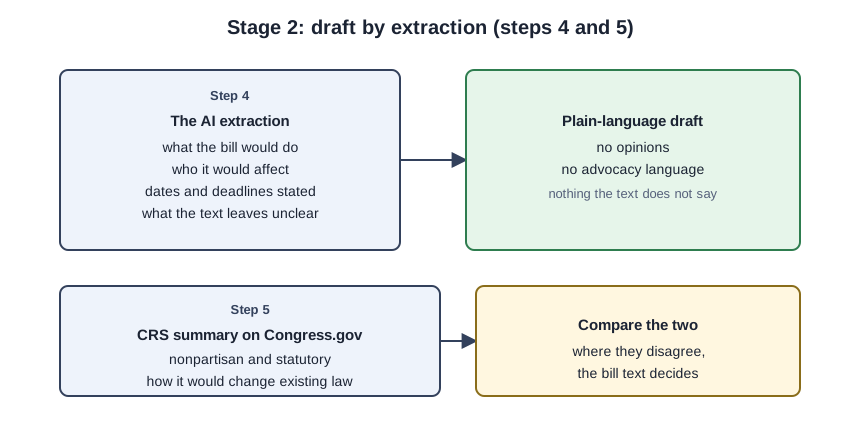
Ask the AI to extract, not to editorialize. Ask for four things in plain member language, no opinions or advocacy language: what the bill would do, who it affects, dates and deadlines stated, and what the text leaves unclear. If the text is silent, the draft says “not in the text.”
-
For a federal bill, read the CRS summary on Congress.gov as ground truth for what the bill would change. The Library of Congress describes CRS summaries as “analytical products that explain precisely how a legislative measure would change existing law”: statutory, nonpartisan, and authoritative. Where the AI draft and the CRS summary disagree, the bill text decides.
Stage 3: verify every line
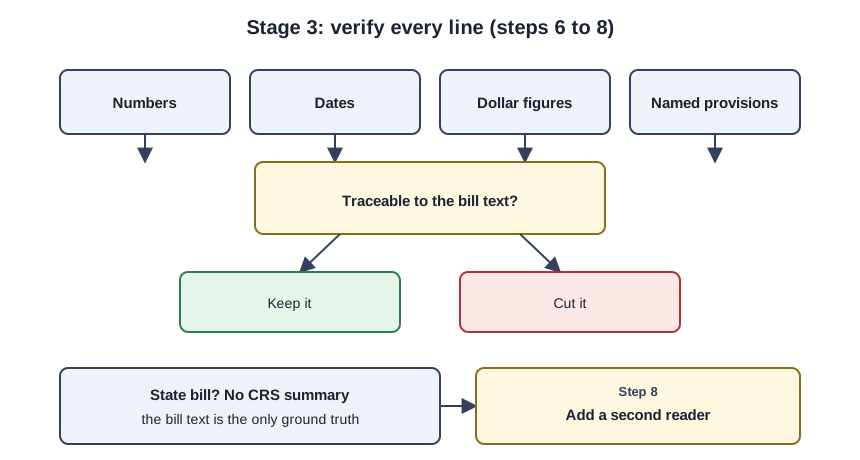
- Trace every number, date, dollar figure, and named provision in the draft back to the bill text, and cut anything the text does not support. Researchers studying abstractive summarization found these models “highly prone to hallucinate content that is unfaithful to the input document,” with annotators finding “substantial amounts of hallucinated content in all model generated summaries” (Maynez et al., ACL 2020). Effective dates, penalty amounts, and agency names are where invented specifics do the most damage in a member alert. Our fact-check routine details the claim-by-claim marking method.
- Give the hardest passages the closest read. Sections that rewrite existing law by reference only make sense against the statute they edit. Read those against the current law, and flag what you cannot parse for your policy colleague.
- For a state bill, add a second reader. CRS summaries cover measures introduced by Congress (Library of Congress); nothing equivalent exists for state bills, so the bill text is your only ground truth and one tired reader is not enough.
Stage 4: write it, sign it, send it
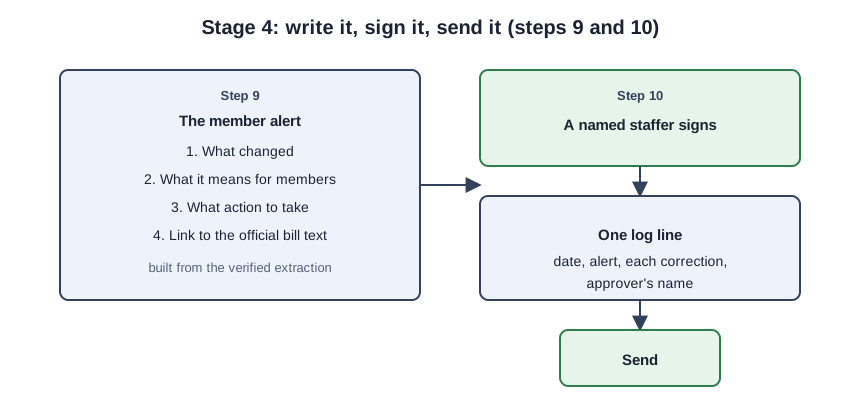
- Write the alert from the verified extraction. Lead with what changed, what it means for the member, and what action to take, then link the official bill text.
- Get a named sign-off and log one line. The UK Parliament’s AI guidance for its members tells them to keep a human in the loop, check AI output closely for accuracy, and remember that “Members are responsible and accountable for how AI tools are used within their offices and for the content created by those AI tools.” That guidance was written for MPs, but the accountability principle travels. One approver, one log line, as our fact-check routine describes.
The alert, worked through once
The association and bill below are invented; treat this as a worked example, not a report of anything real. The Maplewood Retail Merchants Association needs a member alert on a state data-breach bill, so the staffer pulls the official text, notes the version (Introduced), confirms the number, and pastes it into this extraction prompt:
From the bill text pasted below, extract only what the text states:
1. What the bill would do, in plain language
2. Who it would affect
3. Dates and deadlines stated in the text
4. Anything the text leaves unclear
Do not add opinions or advocacy language. Where the text is silent, write "not in the text."

Bill text:
[paste the official text here]
The draft came back like this:
Senate Bill 118 would require retailers to notify customers within 30 days of discovering a breach, with fines of up to $50,000 per violation. The law takes effect January 1, 2027.
The check found three problems in three sentences: 45 days, not 30; no penalty amount anywhere in the bill; “effective upon passage,” not January 1, 2027. Every one of them read fluently.
The signed alert:
Senate Bill 118, introduced last week, would require retailers to notify affected customers within 45 days of discovering a data breach. The bill sets no penalty amount and would take effect upon passage. Read the official text here: [link to the legislature’s page].
The log line:
2026-09-29 | Member alert, SB 118 breach bill | 30-day notice corrected to 45; invented $50,000 penalty cut; invented Jan 1, 2027 effective date cut; "upon passage" restored | Policy directorCheck your result before it sends
Confirm the official source and the written-down version; the number and session match; every number, date, and dollar figure traces to the bill text; federal bills got the CRS comparison and state ones a second reader; the official text is linked; a named staffer signed; the log holds one line. Any gap sends you back to its step.
Mistakes that rewrite the law
Summarizing from the model’s memory produces a confident summary of the wrong bill, sometimes the wrong session’s. Letting the draft invent effective dates, penalty amounts, or agency names ships fiction with your logo on it; these fields look specific and checkable while being neither. An introduced-version summary goes stale after amendments, so re-check the version every time the bill moves. No CRS-style summary exists for a state bill, which is why state alerts get the second reader. Never present an invented number as a finding: one made-up figure in front of the board costs more trust than the alert earned.
Sources
- Maynez et al.: On Faithfulness and Factuality in Abstractive Summarization (ACL 2020)
- Library of Congress: About CRS Bill Summaries
- UK Parliament, Parliamentary Digital Service: Artificial Intelligence Guidance for Members (September 2025)
- U.S. Government Publishing Office: GPO Sees Surge in Use of GovInfo to Access Government Information (press release No. 25-01, January 14, 2025)