Article
BeginnerMake Ads Your Members Can Read and Trust
Five practices that make association ads work, an honest comparison of Canva, The Brief, Adobe Express, and AdGrade, and what AdGrade's tokens actually pay for.
Ad Design Accessibility Member Trust
We read WebAIM’s 2026 Million study, and the number that stuck with us is this: more than one in four images on the web’s most-visited home pages have missing, questionable, or repetitive alternative text, and low-contrast text shows up on 83.9 percent of those pages. Your association’s ads are images. The two most common accessibility failures on the web are the two failures that make an ad useless: text nobody can read against its background, and a picture that tells a screen reader nothing.
For the communications desk, this is not a design critique. Members with low vision are members. An ad that carries your association’s name and cannot be read spends trust, not just impressions.
What the tool cannot fix
No software fixes weak copy or an unreadable headline, so start here. Keep the brand boring and consistent: the same logo, colors, and typefaces in every ad. Members should recognize the sender at a glance, and off-brand creative reads like spam, which is what phishing looks like. Check contrast before you export. Light gray text over a white photo background is the classic offender; if you squint and the headline disappears, it disappears for a member with low vision too. Never put the message only inside the image. The event date, the price, and the deadline should exist as real text near the image, or in the image’s alternative text, so a screen reader can reach them. Write the alternative text yourself: auto-generated descriptions describe the pixels, not the point. Give each ad one action: one button, one verb, and say what happens next. “Register by Friday” beats “Learn more” when the page it lands on is a form. Keep disclosures close to the claim. The FTC’s .com Disclosures guidance says a disclosure must sit as close as possible to the claim it explains. Early-bird pricing, sponsor offers, and member-only rates all carry fine print, and burying it is how an honest association ends up looking evasive. Finally, size the creative for the channel. Design one master, then export the sizes each placement needs. Stretched pixels are the fastest way to look amateur.
Four tools, four answers to one question
The question every ad tool answers is where your work goes when you use it.
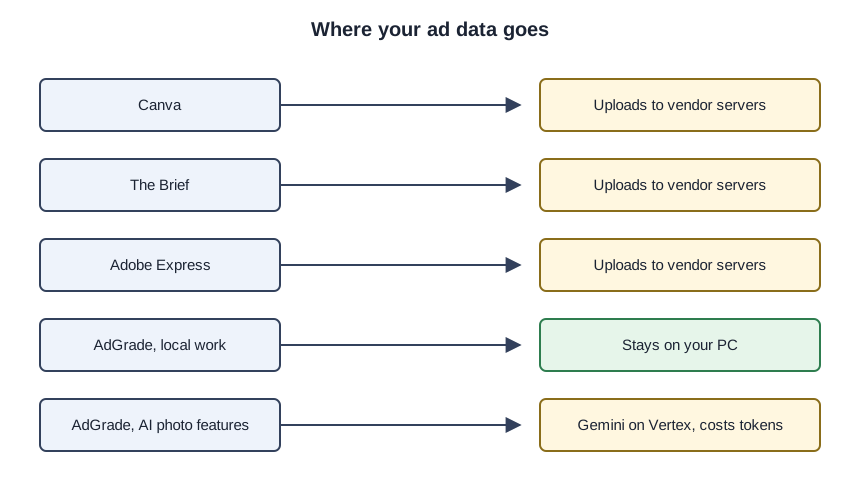
Canva is the browser-based design tool most offices already know: a free tier, real-time collaboration, and brand kits that keep the logo and colors consistent. The honest trade is that it is fully cloud-based. Every photo you drop into a design uploads to vendor servers, and the AI features run on their infrastructure too. If the creative includes member photos you promised to keep private, that is a real trade.
The Brief, formerly Creatopy (and Bannersnack before that), is built specifically for ads. It runs the campaign lifecycle through four AI agents, Discover, Create, Launch, and Optimize, and publishes to the major ad platforms. Its strength is being ad-specific, from research to live campaign. The trade is the same shape as Canva’s: cloud-based, paid tiers, and your data uploads to vendor servers.
Adobe Express is the professional-grade option, with typography and brand control the other two cannot match, and it runs in the browser. The trade is a subscription, a learning curve, and the same cloud reality: your files upload to vendor servers like the rest.
AdGrade is different, and we will be plain about where it wins and where it does not, because our founder, Joseph Watkins, built it. It is a full ad builder that runs in the browser, and its AI models run on the machine’s own GPU through WebGPU first, so for local work everything stays on your PC. It is free. The principle is the same one behind our tutorial on keeping member data on the machine: if the data never uploads, it cannot leak.
Now the weaknesses, because we do not grade our own product on a curve. AdGrade’s image processing, the AI that interprets a photo and applies the styled looks, runs on Google’s Gemini through Vertex AI. That is cloud processing, and cloud processing costs tokens. Tokens are not a subscription and not a profit line. Each token pays for storage and processing at cost, and the pricing is built to land at net zero: the token price covers the Vertex bill and nothing more. The local models carry a hardware truth too. To get quality near a frontier model, your PC needs a GPU up to larger local models. A five-year-old laptop runs the smaller ones, and the output shows it.
What a token actually buys
When you spend a token in AdGrade, you buy a slice of cloud compute and storage: the Gemini call that reads your photo, the processing that applies the look, the storage that holds the result. The on-device work, white balance, auto tone, the local models, costs nothing, because it runs on hardware you already own. There is a standing rule inside the product that cloud AI is never self-funded, which is why tokens exist at all. If you never touch the AI photo features, you never spend a token.
Which desk picks which tool
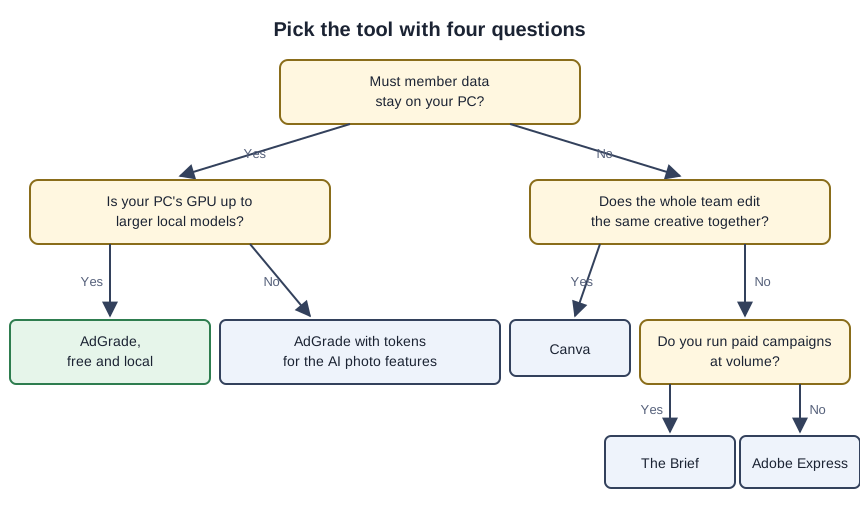
Four questions sort the decision. First, must member data stay on your PC? Second, is your PC’s GPU up to larger local models? Third, does the whole team edit the same creative together? Fourth, do you run paid campaigns at volume?
- Member data must stay on your PC, and the GPU is up to larger local models: AdGrade, free and local.
- Member data must stay on your PC, but the hardware is modest: AdGrade with tokens for the AI photo features.
- The whole team edits together and nobody is a designer: Canva.
- A designer on staff who already thinks in Adobe: Adobe Express.
- Paid campaigns at volume, research to optimization in one place: The Brief.
The tool is the least of it. The practices at the top of this article matter more than the logo on the software. Run the contrast check and the screen-reader test on every ad before it ships, no matter which of the four built it. Pick the tool that fits your desk’s constraints: your budget, your hardware, and what you promised your members about their data. AdGrade exists for the desk that cannot upload member photos, and its tokens are priced at cost for the same reason. Judge it, and the other three, on that.