Article
BeginnerAI and Early-Career Members: Five Sources Agree on Jobs and Split on Young Workers
Public research finds no broad AI job loss so far, while studies of early-career workers disagree. What a membership desk can do before it changes programs or pricing.
Membership Early Career Workforce Research
Graduates in more exposed majors saw a 1.7 percentage point decline in the chance of finding a job in Texas within a year of graduating, relative to graduates of less automatable majors, according to a Federal Reserve Bank of Dallas research note on graduates after 2022. The same note reports that those who did find work earned 5 percent lower wages relative to earnings changes for the less-exposed majors. The note drew on administrative education and earnings records for students and graduates of Texas public universities.
That is a finding about one state’s public university graduates, not about association members. Still, if you run membership or learning programs, you may be asked whether AI is closing the first rung of your members’ profession, and whether dues, programs or credentials for new entrants should change. We read five recent sources, from a university research center, a Stanford research group and three Federal Reserve Banks, to see what they can and cannot answer. None of them studied an association or a single profession.
Where the sources agree: no broad job loss so far
The Budget Lab at Yale University, a university research center, writes on a page updated September 15, 2026 that the occupational mix is not yet changing in ways that clearly align with the introduction of AI, and that measures of AI usage show no connection to changes in employment or unemployment. Its statistical analysis of AI exposure does not yet clearly show an AI-related labor market footprint, and it plans to update the analysis regularly.
A June 30, 2026 blog post from the Federal Reserve Bank of St. Louis concludes that AI is not eliminating jobs across the economy. An August 5, 2026 blog post by the New York Fed’s research director reports that firms in the bank’s regional surveys report very few AI-driven layoffs and overwhelmingly intend to retrain workers rather than fire them as they adopt AI. The post also relays that firms expect more reductions in hiring plans going forward, especially for college-educated workers. It says AI’s labor-market impact has more to do with changing skill requirements than with eliminating jobs, at least so far.
Those three sources use different material: occupation and AI-usage measures, job-opening and unemployment data, and surveys of firms. Their shared message is that the broad labor market has not yet shown an AI job loss.
Where they split: the youngest workers
A Stanford Digital Economy Lab paper, which we read in its November 13, 2025 version, used monthly payroll records through September 2025 from the largest U.S. payroll software provider, covering millions of workers across tens of thousands of firms. It reports that workers ages 22 to 25 in AI-exposed occupations had 16 percent relative employment declines, controlling for firm-level shocks, while employment for experienced workers remained stable. The authors thank the payroll provider for access to the data, and a later version of the paper may differ from the one we read. Its data cover only the firms that use that provider, so employers outside its client base are not represented.
The St. Louis post weighs AI-related job demand against four other factors and finds that it accounted for a meaningful share of the softening labor market conditions for young workers, but that its effects were smaller than those of the broader decline in job openings. The Dallas note, for its part, points the same way as the Stanford paper for new graduates, while the Yale page finds no clear footprint yet in the aggregate.
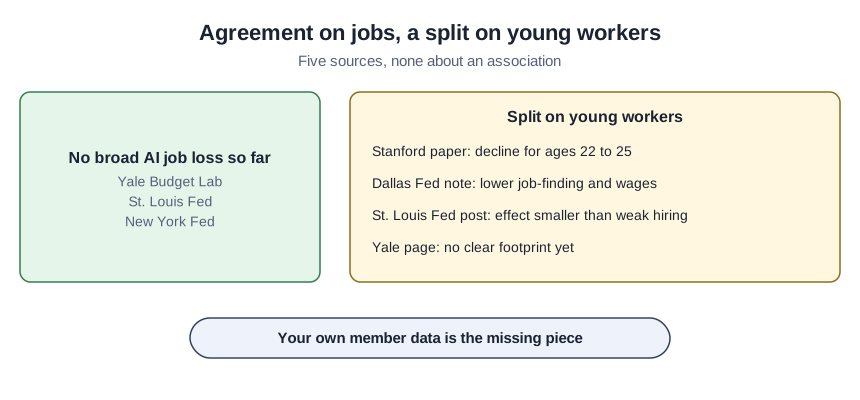
These results are not contradictory on their face, because the Yale page looks at the whole labor market and the Stanford paper at one narrow age group inside it. They also do not settle the question. The five sources use payroll records, Texas graduate records, job-opening data, firm surveys and occupation measures, and each compares exposed and less-exposed groups or periods. None is an experiment, so we read them as associations and not as proof of cause. The Stanford and Dallas figures are also relative: each compares a more-exposed group with a less-exposed one, so neither says how many people lost work or whether the exposed group’s own numbers fell.
The word “exposed” needs care too. The Dallas note builds its measure from a U.S. AI developer’s records of the tasks its own assistant has performed, matched to occupations and then to majors through job postings. A more-exposed major is one whose usual jobs involve tasks that AI tools are seen doing, which is not the same as a count of jobs lost.
What the Dallas note adds on schooling and upskilling
The Dallas note goes beyond hiring. It reports that 2024 graduates from more-exposed fields were more likely to return to school for graduate degrees, though for the most part they kept studying the same field, and that entering undergraduate students have begun to pivot away from AI-exposed fields in the aggregate. It also says the earnings records of recent master’s degree recipients suggest there may be limited returns to formal upskilling in AI-exposed fields.
For a desk weighing a new credential, that last point cuts against assuming that more formal training will pay off, even though the same note says graduates and current students likely benefit from developing skills that complement generative AI. The note covers Texas public university graduates only, and its authors describe the master’s result as a suggestion.
What this means for a membership and learning desk
The evidence supports one claim about your early-career members: the question is open. It does not support telling them that AI is taking entry-level work in their profession, and it does not support telling them that it is not. None of the sources we read is an association-sector study of the question, so whether your field looks more like the Yale aggregate or like the Texas graduates is something only your own records can begin to show. The moves below are ours, not findings from the sources.
- Watch your own early-career numbers. Compare, year over year, how many members in their first years join and how many renew after the first year, before any change to pricing or credentials.
- Ask before you build. Put the same short question to a sample of early-career members and to the employers who hire from your field: which entry-level tasks are changing and which skills are now asked for. The New York Fed post ties AI’s effect so far to changing skill requirements, so skills are the thing to ask about.
- Start small on skills. The Dallas note says recent graduates and current students likely benefit from developing skills that complement generative AI. A pilot workshop on working with AI tools is a reversible way to act on that. The same note’s hint of limited returns to formal upskilling is a reason to wait before building a full credential, and no source here tests whether an association program helps.
Revisit the question when Yale updates its page, since the picture could move either way, and describe anything you tell members now as what the research shows so far. A line such as “public research is split, so the next step is to check our own member numbers” is accurate today and costs nothing to revise.
Sources (5)
- Federal Reserve Bank of Dallas, Dodini and Smith: AI plays a role in weak labor market for college graduates (central bank research note, September 22, 2026)
- The Budget Lab at Yale University: Tracking the Impact of AI on the Labor Market (university research center web page, July 16, 2026, updated September 15, 2026)
- Federal Reserve Bank of St. Louis, Rodgers and Kassens: How Shifts in Labor Supply and Demand Shape Outcomes for Young Workers (On the Economy blog post, June 30, 2026)
- Federal Reserve Bank of New York, Athreya: AI's Impact on Labor and Hiring (Liberty Street Economics blog post by the bank's research director, August 5, 2026)
- Brynjolfsson, Chandar and Chen, Stanford Digital Economy Lab: Canaries in the Coal Mine? Six Facts about the Recent Employment Effects of Artificial Intelligence (research paper, November 13, 2025 version)